
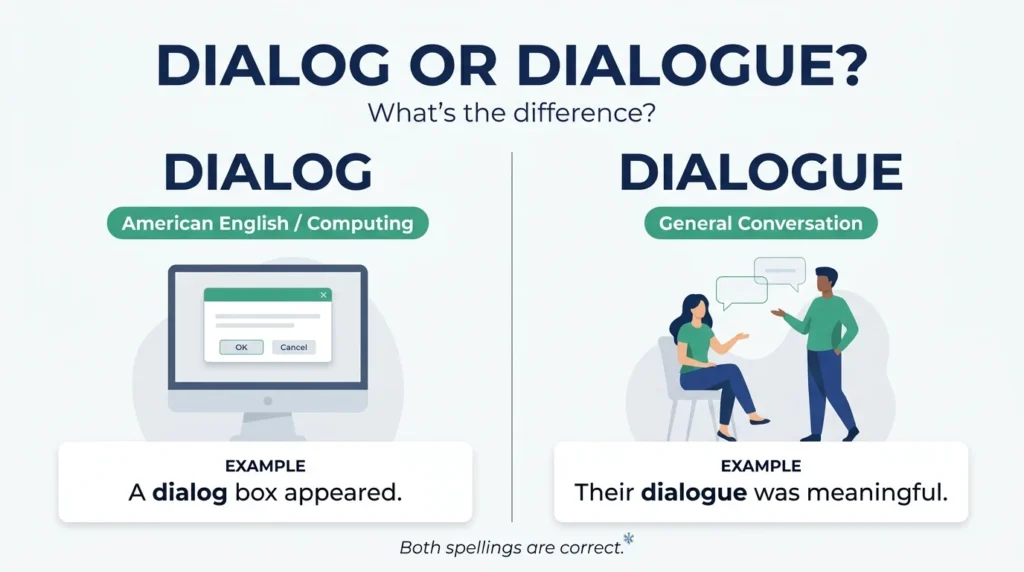

Dialogue is the preferred spelling in British English and the standard choice for conversations, discussions, and spoken exchanges in both British and American writing. Dialog is also correct, particularly in American English, and is widely used in computing terms such as dialog box. The two spellings generally share the same meaning when referring to a conversation, but context and English variety help determine which form to choose.
What Dialog and Dialogue Mean
Both dialog and dialogue are nouns that refer to an exchange of words, ideas, or opinions between two or more people.
They can describe conversations in everyday life, discussions between groups, or spoken exchanges between characters in books, films, and plays.
The main difference is their spelling and conventional usage.
What Does Dialogue Mean?
Dialogue refers to a conversation or an exchange of ideas between two or more people.
It is commonly used in general English, literature, entertainment, education, and professional communication.
Examples:
- The dialogue between the two managers helped resolve the disagreement.
- The film has excellent dialogue.
- Students participated in a dialogue about environmental protection.
- The novel contains realistic dialogue between its main characters.
Dialogue can also refer to formal discussions between opposing groups, organizations, or countries.
For example:
Both governments agreed to continue diplomatic dialogue.
What Does Dialog Mean?
Dialog is an alternative spelling of dialogue, particularly in American English.
It can refer to a conversation, discussion, or exchange of opinions. However, its most recognizable modern use is in computing and software terminology.
Examples:
- The software displayed a dialog box.
- A dialog appeared when I tried to close the application.
- The program opened a confirmation dialog.
- The team continued its dialog about the new project.
In computing, a dialog is an interface element that displays information or requests an action from the user.
The Main Difference Between Dialog and Dialogue
The difference is mainly related to spelling conventions and context rather than a completely different meaning.
| Feature | Dialog | Dialogue |
|---|---|---|
| Meaning | Conversation or discussion | Conversation or discussion |
| Part of speech | Noun | Noun |
| British English | Less common in general writing | Preferred spelling |
| American English | Accepted alternative | Widely used and standard |
| General conversation | Correct, especially in American usage | Preferred in most international writing |
| Literature and films | Acceptable, but less conventional | Standard choice |
| Computing | Common in software terminology | Also encountered in some contexts |
| Example | A confirmation dialog appeared. | Their dialogue was constructive. |
The easiest distinction is:
- Dialogue: The usual choice for conversations and discussions.
- Dialog: A recognized alternative spelling, especially in American English and computing.
Also Read: Curb vs Kerb
The Core Rule
The Rule in Simple English
Use dialogue when writing about conversations, discussions, or exchanges of ideas.
Use dialog when referring to a software interface element, particularly a dialog box, or when following an American English style that prefers the shorter spelling.
Examples:
- Correct: The dialogue between the teachers was productive.
- Correct: A dialog box appeared on the screen.
- Correct: The characters have natural dialogue.
- Correct: The American publication uses the spelling dialog.
Why the Rule Works
English has several words with alternative spellings ending in -og and -ogue.
For example:
- Catalog / Catalogue
- Analog / Analogue
- Dialog / Dialogue
- Monolog / Monologue
American English often accepts simplified -og spellings, while British English generally retains -ogue.
However, the spelling conventions are not identical across every word.
For dialogue, the longer spelling remains widely used in American English too. Therefore, it is inaccurate to assume that Americans always write dialog.
How to Use Dialog and Dialogue
Common Usage
1. Use dialogue for everyday conversations.
When discussing communication between people, dialogue is generally the safest choice.
Example:
Open dialogue helps colleagues understand each other’s concerns.
2. Use dialogue for books, films, and plays.
Dialogue describes the spoken words exchanged by fictional characters.
Example:
The writer spent several weeks improving the dialogue in the screenplay.
3. Use dialogue for formal discussions.
It is frequently used when describing communication between organizations, communities, or opposing groups.
Example:
Constructive dialogue is necessary to resolve the conflict.
4. Use dialog for software interface elements.
In computing, dialog commonly describes a small window that appears on a screen and requires information or confirmation.
Example:
Click OK to close the dialog box.
5. Follow your chosen English spelling convention.
If you are writing for a British English audience, use dialogue. If an American publication or technical style guide prefers dialog, follow that convention consistently.
Less Common or Special Usage
Dialogue can also be used as a verb, although this usage is considerably less common than the noun.
For example:
The representatives dialogued with community leaders about the proposed changes.
The verb can also appear as dialoguing or dialogued.
In everyday communication, however, expressions such as talked with, discussed, and held a dialogue with may sound more natural depending on the sentence.
Correct Examples of Dialog and Dialogue
Here are 12 examples showing how both spellings work in natural English.
1. The dialogue between the employees helped improve workplace communication.
2. The movie’s dialogue was realistic and engaging.
3. The two countries agreed to maintain diplomatic dialogue.
4. Our teacher encouraged an open dialogue about academic challenges.
5. The author created interesting dialogue for every character in the novel.
6. Parents should maintain honest dialogue with their children.
7. A confirmation dialog appeared when I selected the delete option.
8. The application displayed a dialog box asking for permission.
9. The software automatically opened a new dialog window.
10. The American publication allows either dialog or dialogue in general writing.
11. The actors rehearsed their dialogue before the performance.
12. The development team fixed an issue with the login dialog.
Notice that dialogue works naturally in general communication, while dialog is particularly familiar in technical contexts.
Incorrect vs Correct
Not every use of dialog is incorrect. The following table identifies situations where a particular spelling is preferred or where the sentence contains a genuine spelling or usage problem.
| Incorrect or less suitable | Correct or preferred | Why |
|---|---|---|
| Their dialouge was meaningful. | Their dialogue was meaningful. | Incorrect spelling of dialogue. |
| The movie had excellent dialouge. | The movie had excellent dialogue. | The letters are incorrectly arranged. |
| We need an open dialouge. | We need an open dialogue. | Dialogue is the standard spelling. |
| The teacher encouraged dialouge. | The teacher encouraged dialogue. | Incorrect spelling. |
| The film’s dialog was excellent. (British style) | The film’s dialogue was excellent. | British English generally prefers dialogue. |
| Their political dialog continued. (British style) | Their political dialogue continued. | Dialogue is the preferred British spelling. |
| The characters exchanged dialog. (British style) | The characters exchanged dialogue. | Dialogue is the conventional choice. |
| A dialogue box appeared. (US software style) | A dialog box appeared. | Dialog is the conventional American computing term. |
| The software opened a dialouge box. | The software opened a dialog box. | Incorrect spelling and conventional computing usage. |
| The program displayed a dialg box. | The program displayed a dialog box. | The word dialog is misspelled. |
Important: Some examples depend on the selected English variety or technical style guide. For instance, dialog is not grammatically wrong in American general writing, and dialogue box can also be found in British usage.
For more helpful explanations, check out our guide to commonly confused English words.
Why People Confuse Dialog and Dialogue
There are several reasons why these spellings are confusing.
1. They Have Almost Identical Meanings
Both words can describe a conversation or an exchange of ideas.
When two words have the same basic meaning, it becomes difficult to know whether one spelling is incorrect or simply an alternative.
2. American and British Spelling Conventions
English has different spelling conventions across regions.
For example:
- American English: Color
- British English: Colour
- American English: Catalog
- British English: Catalogue
- American English: Dialog / Dialogue
- British English: Dialogue
These patterns make learners assume that dialog is exclusively American and dialogue is exclusively British. The actual usage is more flexible.
3. Computing Has Popularized Dialog
Many computer applications use terms such as:
- Dialog box
- File dialog
- Print dialog
- Confirmation dialog
- Error dialog
People regularly encounter these expressions in software, which reinforces the shorter spelling.
4. The Extra Letters Do Not Change the Pronunciation
Both spellings are pronounced essentially the same way.
The additional letters -ue do not create a separate pronunciation in modern English.
This makes the difference harder to recognize when learning through speech rather than reading.
Common Mistakes
Mistake 1: Assuming Dialog Is Always Incorrect
Some learners believe dialogue is the only acceptable spelling.
That is incorrect.
Dialog is a recognized English spelling, especially in American usage and computing.
Mistake 2: Assuming Dialog Is Always American and Dialogue Is Always British
Although regional preferences exist, both spellings are used in American English.
Dialogue is also widely understood and accepted internationally.
Mistake 3: Using Dialog and Dialogue Randomly
Both spellings can be correct, but switching between them without a reason can make an article or document look inconsistent.
Choose one spelling convention and maintain it throughout your writing.
Mistake 4: Confusing Dialogue With Monologue
Dialogue involves an exchange between participants.
A monologue is an extended speech delivered by one person.
For example:
- Dialogue: Two characters discuss their plans.
- Monologue: One character delivers a long speech.
These words are related but do not describe the same type of communication.
Dialog and Dialogue in Real English
In actual English writing, the choice depends on the context, audience, and style.
Correct and Natural
The dialogue between the two colleagues was constructive.
This is natural in both British and American English.
A dialog box appeared when I opened the application.
This is natural technical terminology, particularly in American English.
Correct but Less Common
The film’s dialog was interesting.
This is acceptable in American English, although dialogue is the more conventional choice in general literary and film writing.
Possible but Unusual
The two representatives dialogued for several hours.
The verb dialogued is grammatically possible, but many speakers would prefer:
The two representatives talked for several hours.
Or:
The two representatives held a dialogue for several hours.
Incorrect
The film contained excellent dialouge.
The spelling dialouge is incorrect. The correct spelling is dialogue.
American vs British English
There is a genuine regional preference between these spellings.
| Context | American English | British English |
|---|---|---|
| General conversation | Dialogue / Dialog | Dialogue |
| Film and literary writing | Dialogue / Dialog | Dialogue |
| Formal discussion | Dialogue / Dialog | Dialogue |
| Software interface | Dialog | Dialog / Dialogue, depending on convention |
| General recommendation | Dialogue | Dialogue |
American English
American English accepts both dialog and dialogue.
However, dialogue remains a widely established spelling in ordinary writing, literature, and formal communication.
Dialog is especially familiar in technical and software-related terminology.
British English
British English generally prefers dialogue for conversations, discussions, and literary writing.
The spelling dialog is less common in general British writing but can appear in computing terminology.
For Pakistani English: Since British spelling conventions are commonly followed in formal and educational writing, dialogue is the safer choice for general use.
Formal vs Informal Usage
Formal Usage
In formal writing, dialogue is generally preferred when referring to discussions, negotiations, and communication.
Examples:
- The organization encourages constructive dialogue between employees.
- Both parties agreed to establish a channel of dialogue.
- The conference promoted dialogue between academic institutions.
In technical documentation, dialog may be used when referring to software components.
Everyday Usage
In everyday communication, dialogue is commonly used for conversations.
Examples:
- We had a good dialogue about our future plans.
- I enjoyed the dialogue in that movie.
- The discussion created an opportunity for open dialogue.
In informal speech, people more commonly say conversation, chat, or discussion rather than explicitly choosing between the two spellings.
Also Read: Whos vs Whose
Comparison Table: Dialog vs Dialogue
| Feature | Dialog | Dialogue |
|---|---|---|
| Basic meaning | Conversation | Conversation |
| Word type | Noun | Noun |
| Spelling | Shorter | Longer |
| British preference | Less common | Preferred |
| American usage | Accepted | Widely used |
| Software terminology | Common | Also possible |
| Literary writing | Acceptable in American usage | Conventional |
| Formal discussions | Accepted | Preferred |
| Pronunciation | Same | Same |
| Safest general choice | Context-dependent | Yes |
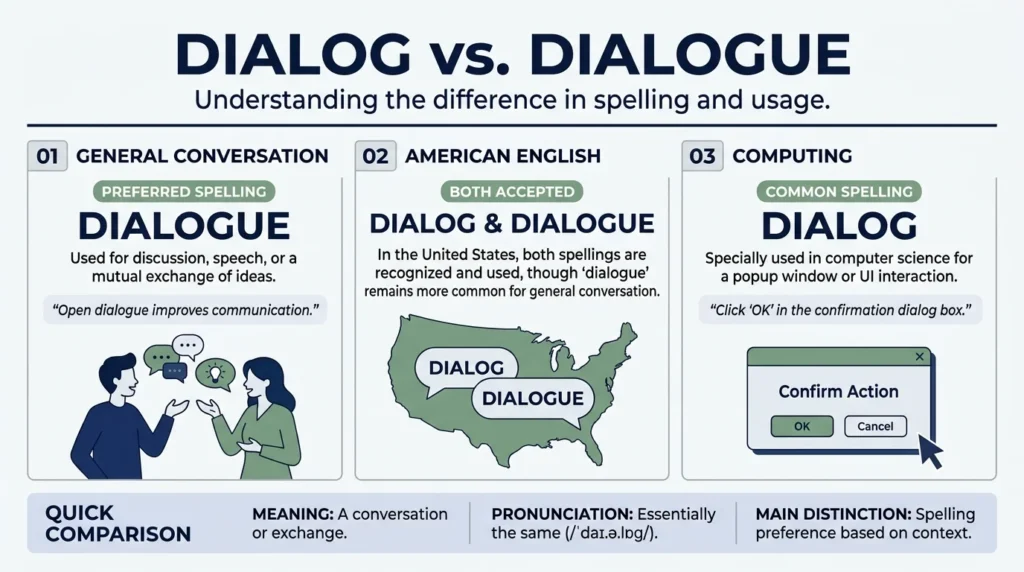
Memory Trick
Remember this simple technique:
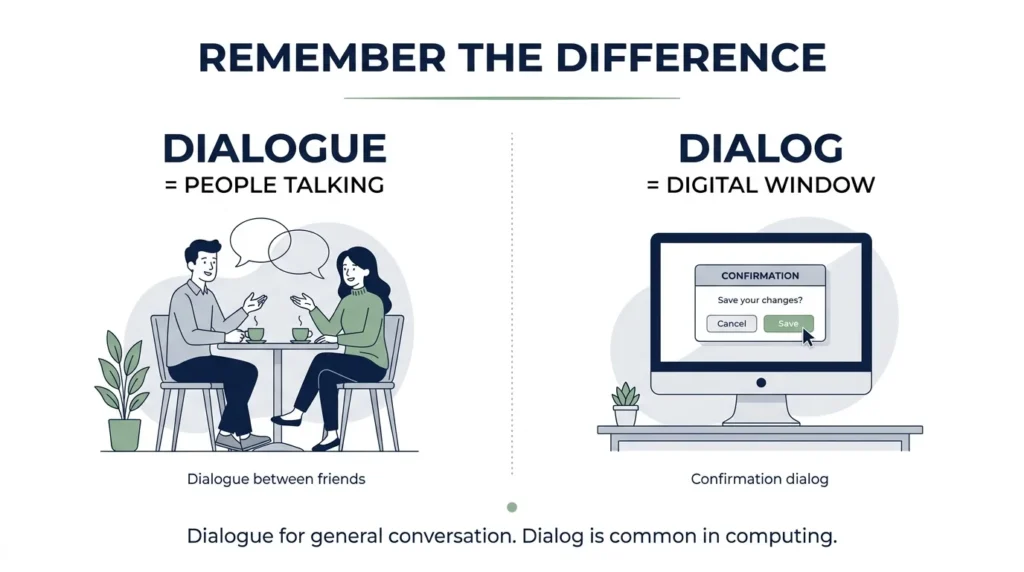
Dialogue = People talking.
Think of the extra letters in dialogue as part of the traditional spelling used for conversations, stories, and discussions.
Dialog = Digital dialog box.
Think of the shorter spelling as the one commonly seen in computer interfaces.
Easy memory formula
DIALOGUE
Conversation
People, discussions, books, films and negotiations.
DIALOG
Computing
Software windows, confirmation boxes and interface messages.
Remember that this is a practical preference, not an absolute rule. Dialog can also mean a conversation.
Real-Life Examples
At Work
Open dialogue between employees and management can improve workplace relationships.
In an Email
I would appreciate the opportunity to continue this dialogue and discuss the proposed changes.
In Conversation
We had an interesting dialogue about our career goals.
At School or University
The classroom dialogue encouraged students to share their opinions and challenge different perspectives.
In Software Development
The application displays a confirmation dialog before permanently deleting a file.
In Film and Entertainment
The director wanted the dialogue to sound natural rather than scripted.
Expert Tips
1. Choose dialogue for general writing. It is the safest option for conversations, literature, and formal discussions.
2. Recognize dialog in technology. If you see dialog box, file dialog, or confirmation dialog, the shorter spelling is conventional.
3. Do not assume dialog is misspelled. It is a legitimate spelling variation.
4. Follow your audience’s spelling conventions. British-oriented writing generally favors dialogue.
5. Stay consistent. Avoid randomly alternating between dialog and dialogue in the same document.
6. Understand the context before correcting someone. A dialog box is not automatically a spelling mistake.
7. Remember that both forms are pronounced alike. The difference is primarily written rather than spoken.
For more helpful explanations, check out our guide to Commonly Confused English words.
Quick Summary
Dialog and dialogue are two accepted spellings of a word that refers to a conversation or exchange of ideas. Dialogue is the preferred British English spelling and remains widely used in American English. Dialog is also accepted in American English and is particularly common in computing expressions such as dialog box and confirmation dialog. The two forms do not have completely separate meanings, although their typical contexts differ. For general writing, academic work, literature, films, and professional communication, dialogue is the safest choice. When discussing software interfaces, dialog is a conventional spelling. Always consider your audience, follow the appropriate style, and maintain consistency throughout your writing.
Frequently Asked Questions
1. Is it dialog or dialogue?
Both spellings are correct. Dialogue is generally preferred for conversations and discussions, while dialog is especially common in American English computing terminology.
2. Is dialogue British or American English?
Dialogue is used in both British and American English. It is the preferred British spelling and remains widely accepted in American writing.
3. Is dialog correct in American English?
Yes. Dialog is an accepted American English spelling. It can refer to a conversation or a software interface element.
4. Is dialogue more formal than dialog?
Not necessarily. The two forms are spelling variants rather than different levels of formality. However, dialogue is more conventional in general formal and literary writing.
5. Should I write dialog box or dialogue box?
Dialog box is the conventional spelling in American software terminology and is widely used internationally in computing. Dialogue box also occurs, particularly in British contexts, but dialog box is the familiar technical form.
6. Do dialog and dialogue have the same pronunciation?
Yes. They are pronounced essentially alike. The difference is in their written spelling, not their normal pronunciation.
7. Can dialogue be used as a verb?
Yes. Dialogue can function as a verb meaning to engage in conversation or discussion, although this use is less common than the noun.
Example: The representatives dialogued with local residents.
8. What is the plural of dialogue?
The plural is dialogues.
The plural of dialog is dialogs.
Examples:
- The film contains several memorable dialogues.
- The software displays multiple dialogs.
In literary and conversational contexts, dialogue is also commonly used as an uncountable noun.
If you want to learn about another commonly confused pair of English words, check out our guide to Dialog vs Dialogue
Mini Quiz
Test your understanding of dialog and dialogue.
| # | Question | Answer | Explanation |
|---|---|---|---|
| 1 | Which spelling is generally preferred in British English? | Dialogue | British English generally retains the -ogue ending. |
| 2 | Complete: The movie had excellent _____. | Dialogue | Dialogue is the conventional spelling for conversations in films. |
| 3 | Which spelling is commonly used in American software terminology: dialog or dialogue? | Dialog | Dialog box is the familiar technical expression. |
| 4 | Is dialog always incorrect? | No | It is an accepted spelling variation. |
| 5 | Complete: A confirmation _____ appeared on my screen. | Dialog | Dialog is conventional in computing terminology. |
| 6 | What is the plural of dialogue? | Dialogues | The plural is formed by adding -s. |
| 7 | Are dialog and dialogue pronounced differently? | No | Their pronunciation is essentially the same. |
| 8 | Correct the spelling: Their dialouge was interesting. | Their dialogue was interesting. | Dialouge is a misspelling. |
| 9 | Which word describes an extended speech by one person: dialogue or monologue? | Monologue | A monologue is a speech delivered by one speaker. |
| 10 | Which spelling is the safest choice for general formal writing? | Dialogue | It is widely accepted across English varieties. |


Pingback: Evoke vs Invoke: Meaning, Difference & Examples