
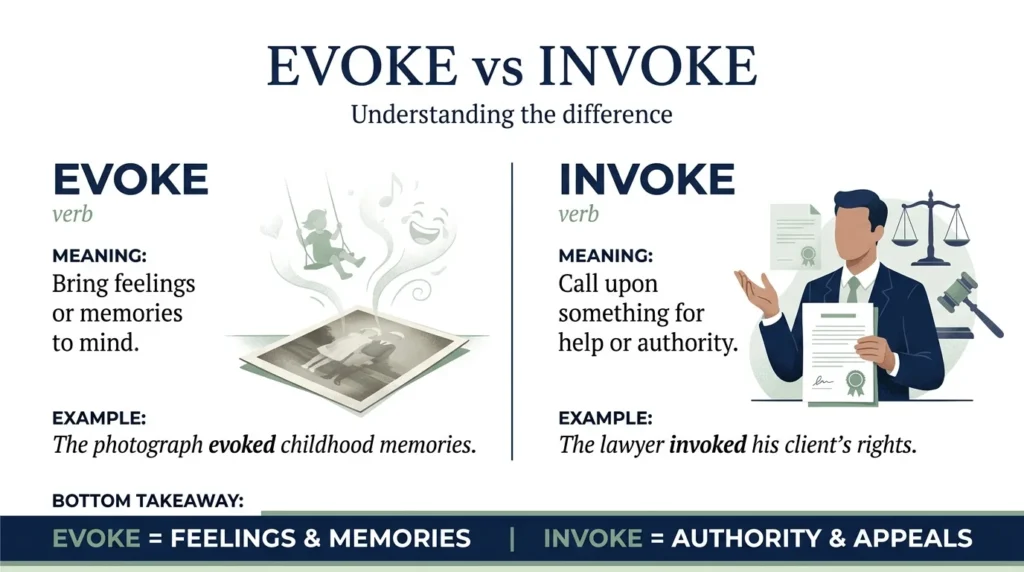

Evoke and invoke are both verbs that involve calling something forth, but they are used in different ways. Evoke means to bring a feeling, memory, image, or reaction to someone’s mind. Invoke means to call upon something for help, support, or authority, or to put a law, rule, or power into effect. For example, a beautiful photograph can evoke childhood memories, while a lawyer can invoke a legal right. The key difference is what is being called forth and why.
What Evoke and Invoke Mean
Although evoke and invoke look and sound similar, they communicate different actions. Both are verbs, but their meanings and common contexts are not interchangeable.
What Does Evoke Mean?
Evoke means to bring something into someone’s mind or to produce a particular feeling, memory, image, or reaction.
It is commonly used when something reminds a person of an experience or creates an emotional or mental response.
Examples:
- The smell of fresh bread evoked memories of my childhood.
- Her speech evoked a strong emotional response.
- The painting evokes a sense of peace and happiness.
- His description of the village evoked vivid images in my mind.
Evoke is especially common in literature, art, storytelling, music, photography, and descriptions of personal experiences.
It can also mean to suggest or recreate something through imagination.
For example:
The old building’s architecture evokes the atmosphere of another century.
Here, the architecture creates an impression of the past without actually bringing the past back.
What Does Invoke Mean?
Invoke means to call upon someone or something for help, support, authority, or protection. It can also mean to refer to a law, rule, principle, or power as a basis for an action.
It is commonly used in legal, religious, formal, political, and technical contexts.
Examples:
- The lawyer invoked his client’s constitutional rights.
- The villagers invoked the protection of their ancestors.
- The manager invoked company policy to explain the decision.
- She invoked the help of her colleagues during the difficult project.
Invoke can also mean to summon a supernatural being or spirit.
For example:
The characters attempted to invoke an ancient spirit.
In computing, invoke can mean to initiate or execute a function, command, or process.
For example:
The application invokes a function when the user clicks the button.
The Main Difference Between Evoke and Invoke
The main difference is the action each word describes.
- Evoke: To bring a feeling, memory, image, or response to mind.
- Invoke: To call upon something, appeal to authority, or put a rule or power into effect.
Consider these two sentences:
Evoke:
The old photograph evoked memories of my school days.
The photograph brought past experiences into the person’s mind.
Invoke:
The employee invoked company policy to challenge the decision.
The employee referred to an established rule to support an argument.
The words can overlap in certain contexts, particularly when referring to supernatural summoning. However, their ordinary uses are different.
Quick Comparison
| Feature | Evoke | Invoke |
|---|---|---|
| Main meaning | Bring to mind or produce a response | Call upon or appeal to |
| Part of speech | Verb | Verb |
| Common context | Emotions, memories, images | Laws, rules, authority, assistance |
| Typical action | Trigger or suggest | Appeal to or summon |
| Example | The music evoked nostalgia. | He invoked his legal rights. |
| Main focus | Mental or emotional response | Calling upon something for a purpose |
Also Read: Dialog vs Dialogue
The Core Rule
The Rule in Simple English
Use evoke when something brings a memory, feeling, image, or reaction into someone’s mind.
Use invoke when someone calls upon a person, power, authority, law, or rule for a particular purpose.
Remember:
- A song can evoke emotions.
- A photograph can evoke memories.
- A speech can evoke sympathy.
- A lawyer can invoke a law.
- A person can invoke their rights.
- Someone can invoke divine protection.
Why the Rule Works
The distinction becomes easier when you focus on the direction of the action.
With evoke, something produces or draws out a response in someone’s mind.
For example:
The story evoked sympathy among the readers.
The story caused readers to experience sympathy.
With invoke, someone deliberately calls upon something or appeals to it.
For example:
The lawyer invoked the principle of equality.
The lawyer referred to an established principle to support an argument.
This is a useful distinction, but it is not an absolute rule. Both words have additional meanings, and they can overlap when referring to summoning spirits or bringing something forth.
How to Use Evoke and Invoke
Common Usage
1. Use evoke for memories.
When something reminds you of an earlier experience, evoke is generally the natural choice.
Example:
The smell of jasmine evoked memories of my grandmother’s garden.
2. Use evoke for emotions.
When something creates an emotional response, use evoke.
Example:
The documentary evoked sympathy for the affected families.
3. Use evoke for images and impressions.
When a description, painting, or piece of music creates a mental picture, evoke is appropriate.
Example:
The author’s description evoked images of a peaceful countryside.
4. Use invoke for laws and rights.
When someone formally refers to a law, regulation, or legal right to support an action, use invoke.
Example:
The citizen invoked his right to freedom of expression.
5. Use invoke for help or protection.
When someone calls upon a person, deity, or higher power for assistance, invoke is appropriate.
Example:
The community invoked divine protection during the difficult times.
6. Use invoke for rules and policies.
When someone relies on an established rule or policy to justify a decision, invoke is appropriate.
Example:
The supervisor invoked the company’s attendance policy.
7. Use invoke in computing.
When a program initiates a function, method, or process, invoke is commonly used.
Example:
The system invokes the authentication function before granting access.
Less Common or Special Usage
The two verbs have some overlapping meanings.
Evoke can mean to summon something.
Although its most familiar use concerns memories and emotions, evoke can also mean to call forth or summon something, including a spirit.
Example:
The ceremony was intended to evoke the spirit of an ancient ancestor.
Invoke can also be used with emotions or reactions.
For example:
The controversial decision invoked strong reactions from the public.
This construction is possible, but in ordinary English, provoked strong reactions or evoked strong reactions may be more natural depending on the intended meaning.
Invoke can also mean to bring something into operation.
Example:
The developer invoked the system’s backup procedure.
The important point is that the correct verb depends on the intended action, not simply the noun that follows it.
Correct Examples of Evoke and Invoke
Here are 14 examples showing how both verbs work in natural English.
Examples of Evoke
1. The old family photographs evoked beautiful memories of our childhood.
2. Her emotional speech evoked tears among the audience.
3. The sound of rain evokes a feeling of relaxation.
4. The novel’s opening chapter evoked a mysterious atmosphere.
5. His words evoked sympathy from everyone in the room.
6. The traditional music evoked memories of our hometown.
7. The painting evokes the beauty of the natural world.
Examples of Invoke
8. The lawyer invoked the constitutional rights of his client.
9. The manager invoked company policy to explain the decision.
10. The community invoked divine protection during the crisis.
11. The government invoked emergency powers to manage the situation.
12. She invoked the support of her colleagues before presenting the proposal.
13. The developer invoked a function to process the user’s request.
14. The organization invoked its contractual rights after the agreement was violated.
Notice how evoke generally introduces a mental or emotional response, while invoke commonly introduces something being called upon, cited, or put into operation.
Incorrect vs Correct
The following examples show common mistakes and explain which verb communicates the intended meaning more accurately.
| Incorrect or less suitable | Correct or preferred | Why |
|---|---|---|
| The photograph invoked childhood memories. | The photograph evoked childhood memories. | Evoke is the natural choice for recalling memories. |
| Her speech invoked sympathy among listeners. | Her speech evoked sympathy among listeners. | The speech produced an emotional response. |
| The music invoked nostalgia. | The music evoked nostalgia. | Evoke describes bringing nostalgic feelings to mind. |
| The painting invoked a feeling of peace. | The painting evoked a feeling of peace. | The painting produced an emotional impression. |
| The smell invoked memories of home. | The smell evoked memories of home. | The smell brought past experiences to mind. |
| The lawyer evoked his constitutional rights. | The lawyer invoked his constitutional rights. | Invoke means to appeal to or rely on legal rights. |
| The manager evoked company policy. | The manager invoked company policy. | The manager referred to an established rule. |
| The government evoked emergency powers. | The government invoked emergency powers. | Invoke is used for putting powers into effect. |
| The developer evoked a function. | The developer invoked a function. | Invoke means to execute or call a function. |
| She evoked the assistance of her colleagues. | She invoked the assistance of her colleagues. | Invoke is appropriate when calling upon someone for help. |
Important: These are corrections for the intended meanings shown. Some combinations can be grammatically possible in unusual or figurative contexts, so the choice should not be treated as an absolute ban.
For more helpful explanations, check out our guide to commonly confused English words.
Why People Confuse Evoke and Invoke
There are several reasons these words are frequently confused.
1. Similar Spelling
Both words end in -voke and contain almost identical letter patterns.
- Evoke
- Invoke
Only the beginning changes, making it easy to select the wrong word while writing quickly.
2. Similar Pronunciation
Both words share the same ending sound, which can make them difficult to distinguish for English learners.
However, their opening sounds are different:
- Evoke: ih-VOHK
- Invoke: in-VOHK
The pronunciation difference is subtle but noticeable.
3. Related Meanings
Both words are associated with calling something forth.
Evoke generally concerns drawing out an emotion, memory, or impression.
Invoke generally concerns calling upon something for help, authority, or action.
Because these concepts are related, learners sometimes assume that the words are interchangeable.
4. Overlapping Contexts
Both words can be used when discussing supernatural spirits.
For example:
- The ritual was intended to evoke an ancient spirit.
- The ritual was intended to invoke an ancient spirit.
Both sentences are possible, although invoke more directly suggests calling upon or summoning the spirit.
5. First-Language Interference
English learners may translate both verbs using the same word in their first language.
This can create confusion because one translated expression may cover several different English meanings.
Understanding the action behind each word is more reliable than memorizing a single translation.
Common Mistakes
Mistake 1: Using Invoke for Every Emotional Reaction
A common mistake is using invoke whenever something produces an emotional response.
Example:
The movie invoked memories of my childhood.
Although the meaning may be understood, evoked memories is more natural.
Better:
The movie evoked memories of my childhood.
Mistake 2: Using Evoke When Referring to Legal Rights
Evoke is not the usual choice when someone formally appeals to a legal right or regulation.
Example:
The lawyer evoked the client’s right to remain silent.
Better:
The lawyer invoked the client’s right to remain silent.
Mistake 3: Assuming Both Words Are Completely Interchangeable
The words share some meaning, but replacing one with the other can change the sentence.
For example:
- The music evoked the spirit of Mozart. (It reminded listeners of his style.)
- The ceremony invoked the spirit of an ancestor. (It called upon or summoned that spirit.)
The context determines the intended meaning.
Mistake 4: Thinking Invoke Is Used Only in Legal Writing
Invoke is common in legal language, but it is not limited to law.
It can also be used for assistance, religious appeals, supernatural summoning, principles, and computer functions.
Evoke and Invoke in Real English
Understanding the difference between grammatical correctness and natural usage is important.
Correct and Natural
The photograph evoked memories of our first family vacation.
The photograph triggered memories.
The lawyer invoked the relevant legal provision.
The lawyer relied on a legal provision.
These are natural and conventional uses.
Correct but Context-Dependent
The ritual evoked the spirit of an ancient civilization.
This can mean that the ritual brought the spirit or atmosphere of that civilization to mind.
The ritual invoked an ancient spirit.
This suggests an attempt to summon or call upon a supernatural being.
Possible but Less Natural
The announcement invoked feelings of uncertainty.
This is understandable, but evoked feelings of uncertainty is generally a more natural choice when describing an emotional response.
Incorrect for the Intended Meaning
The photograph invoked memories of my childhood.
If the intended meaning is that the photograph reminded someone of their childhood, evoked is the better choice.
The lesson is simple: choose the word based on the relationship between the action and its object.
Formal vs Informal Usage
Formal Usage
Both verbs are suitable for formal writing, but they appear in different contexts.
Evoke is commonly used in:
- Academic writing about literature and art.
- Psychological descriptions.
- Literary criticism.
- Cultural discussions.
- Emotional and social analysis.
Examples:
The study examines how visual imagery evokes emotional responses.
The novel evokes a strong sense of historical authenticity.
Invoke is commonly used in:
- Legal documents.
- Government communication.
- Academic arguments.
- Religious discussions.
- Technical documentation.
Examples:
The applicant invoked the relevant provisions of the agreement.
The researcher invoked an established theoretical framework to support the argument.
Everyday Usage
In everyday English, evoke is common when describing feelings and memories.
Examples:
- That song evokes so many memories.
- The smell of coffee evokes a feeling of comfort.
Invoke appears more often in situations involving formal appeals, authority, or specific actions.
Examples:
- He invoked his right to refuse.
- The manager invoked the office rules.
Neither word is exclusively formal, but invoke often has a more formal tone in its legal and authoritative uses.
Also Read: Curb vs Kerb
Comparison Table: Evoke vs Invoke
| Feature | Evoke | Invoke |
|---|---|---|
| Part of speech | Verb | Verb |
| Main meaning | Bring to mind or produce | Call upon or appeal to |
| Common objects | Memories, feelings, images | Laws, rights, powers, help |
| Main context | Art, emotions, literature | Law, authority, religion, technology |
| Focus | Mental or emotional response | Appeal, summoning, or activation |
| Pronunciation | ih-VOHK | in-VOHK |
| Related noun | Evocation | Invocation |
| Common adjective | Evocative | Invocative |
| Example | The song evoked nostalgia. | The lawyer invoked the law. |
Memory Trick
The easiest way to remember these words is to connect their first letters with their common uses.
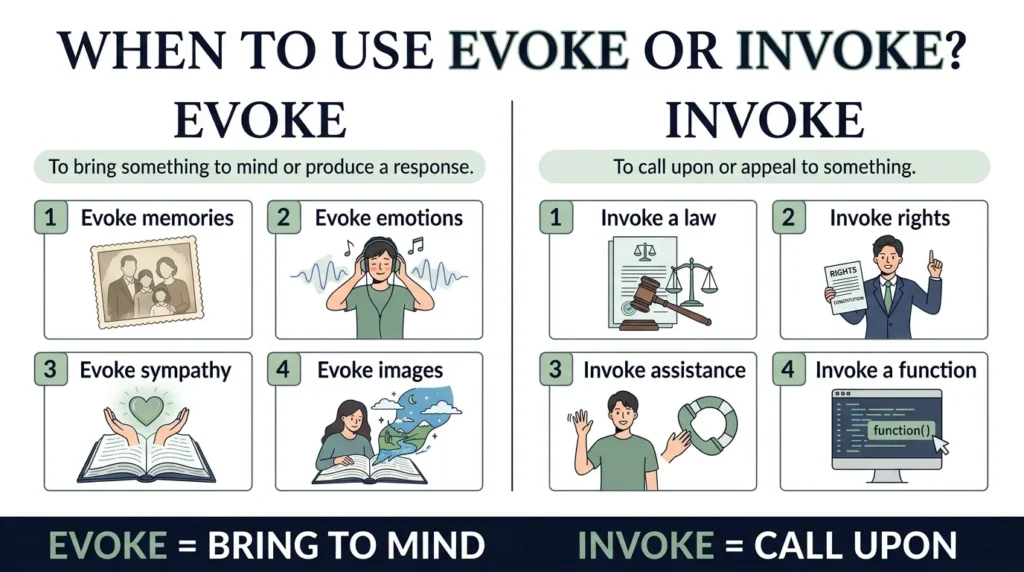
EVOKE = EMOTIONS
Think of E for emotions.
Use evoke when something brings feelings, memories, or images to mind.
Examples:
- Evoke happiness.
- Evoke nostalgia.
- Evoke memories.
- Evoke sympathy.
INVOKE = IN CALLING UPON
Think of invoke as calling upon something for a purpose.
Examples:
- Invoke a law.
- Invoke a right.
- Invoke assistance.
- Invoke protection.
EVOKE
Emotions and memories
Feelings
A song evokes memories. A painting evokes emotions.
INVOKE
Authority and assistance
Calling upon
A lawyer invokes a law. A person invokes protection.
Remember: this is a memory aid, not a strict grammatical rule. Invoke has meanings beyond authority, and evoke is not limited to emotions.
Real-Life Examples
At Work
The manager invoked company policy to explain why the employee’s request could not be approved.
The team’s success story evoked a sense of pride among employees.
In an Email
Your message evoked positive memories of our previous collaboration.
I would like to invoke the terms of our original agreement regarding the payment schedule.
In Conversation
That old song always evokes memories of my university days.
You cannot simply invoke company rules without explaining how they apply.
At School or University
The teacher used historical photographs to evoke interest in the subject.
The researcher invoked a well-established theory to support the conclusion.
In Literature and Art
The poet uses vivid descriptions to evoke feelings of loneliness and longing.
The author invokes classical mythology to strengthen the novel’s central theme.
In Technology
The application invokes a background process whenever a user submits a form.
The visual design evokes the appearance of traditional printed books.
Expert Tips
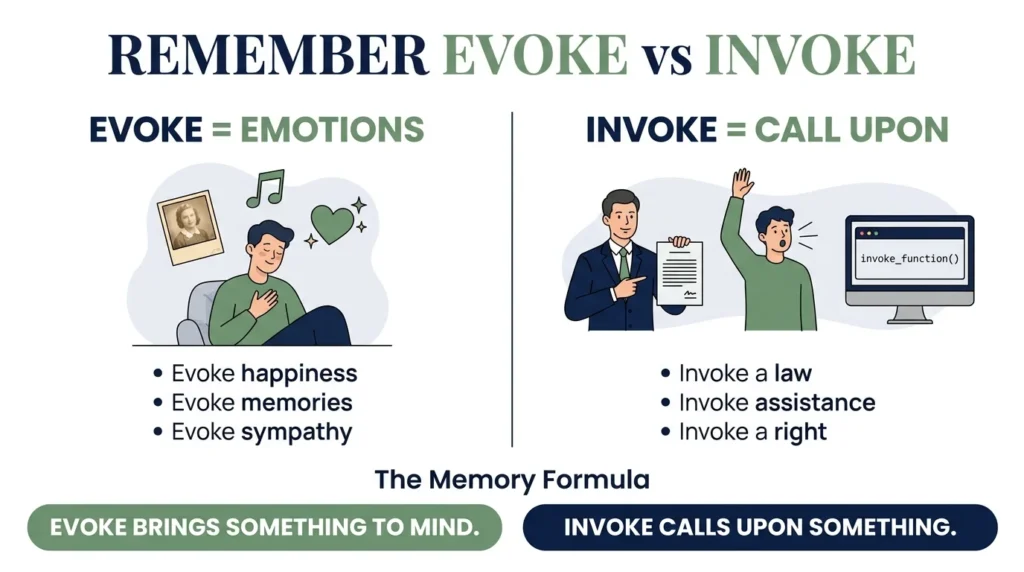
1. Check the intended action. Ask yourself whether something is bringing a feeling to mind or calling upon a rule, person, or power.
2. Associate evoke with mental responses. Memories, nostalgia, sympathy, images, and emotions commonly accompany evoke.
3. Associate invoke with appeals. Laws, rights, authority, protection, assistance, and functions commonly accompany invoke.
4. Pay attention to the subject. A photograph can evoke memories, while a lawyer can invoke legal rights.
5. Remember the overlapping meaning. Both verbs can refer to summoning a spirit, so context matters.
6. Learn common word combinations. Memorize expressions such as evoke memories, evoke sympathy, invoke a law, and invoke a right.
7. Do not rely only on translation. Understand what the speaker is trying to communicate before choosing the verb.
8. Check naturalness, not just grammar. A sentence can be understandable but still use a less suitable verb.
For more helpful explanations, check out our guide to Commonly Confused English words.
Quick Summary
Evoke and invoke are similar-looking verbs with different common uses. Evoke means to bring memories, emotions, images, or impressions to someone’s mind. Invoke means to call upon something for assistance, appeal to an authority, cite a law, or put a rule or power into effect. For example, a photograph can evoke childhood memories, while a lawyer can invoke constitutional rights. Both words can also be used in the context of summoning spirits, so their meanings occasionally overlap. The easiest way to remember the difference is to associate evoke with emotional and mental responses and invoke with calling upon something for a purpose. Always consider the intended meaning and context before choosing between them.
Frequently Asked Questions
1. What is the main difference between evoke and invoke?
Evoke means to bring a memory, feeling, or image to mind. Invoke means to call upon something for help, authority, or support, or to put a rule or power into effect.
2. Can evoke and invoke be used interchangeably?
Generally, no. Evoke is usually associated with feelings, memories, and impressions, while invoke is commonly used for laws, rights, authority, and assistance. They can overlap in certain contexts, particularly supernatural summoning.
3. Is evoke used for emotions?
Yes. Evoke is commonly used when something produces or brings out an emotional response.
Example:
Her story evoked sympathy among the listeners.
4. Is invoke used in legal writing?
Yes. Invoke is frequently used in legal contexts when someone appeals to a law, regulation, constitutional right, or legal principle.
Example:
The lawyer invoked the client’s right to remain silent.
5. Can you evoke a memory?
Yes. Evoke is the natural choice when something causes a memory to come to mind.
Example:
The old photograph evoked memories of my childhood.
6. Can you invoke a person?
Yes. Invoke can mean to call upon someone for help, support, or assistance. It can also refer to calling upon a deity or supernatural being.
Example:
The community invoked the guidance of its spiritual leader.
7. What is the difference between evoke and provoke?
Evoke means to bring a feeling, memory, or response to mind. Provoke generally means to cause or stimulate a reaction, often deliberately.
Examples:
- The song evoked happiness.
- His rude comments provoked an argument.
8. What is the noun form of evoke and invoke?
The noun form of evoke is evocation, while the noun form of invoke is invocation.
Examples:
- The painting’s evocation of nostalgia was remarkable.
- The ceremony began with an invocation.
9. Are evoke and invoke pronounced the same way?
No. They have similar endings but different opening sounds.
- Evoke: /ɪˈvoʊk/
- Invoke: /ɪnˈvoʊk/
Invoke contains an additional /n/ sound after its opening syllable.
10. Can invoke be used in computer programming?
Yes. In programming, invoke means to call or execute a function, method, command, or process.
Example:
The application invokes the authentication method when a user logs in.
If you want to learn about another commonly confused pair of English words, check out our guide to Evoke vs Invoke
Mini Quiz: Evoke vs Invoke
| # | Question | Options | Correct Answer |
|---|---|---|---|
| 1 | Which verb means to bring a memory, feeling, or image to mind? | A) Evoke B) Invoke C) Provoke D) Advocate | A) Evoke |
| 2 | The lawyer decided to ___ the client’s legal rights. | A) Evoke B) Invoke C) Awaken D) Recall | B) Invoke |
| 3 | Which sentence uses “evoke” correctly? | A) The painting evoked childhood memories. B) The judge evoked the law. C) She evoked her rights. D) The programmer evoked a function. | A |
| 4 | The ceremony was designed to ___ a sense of national pride. | A) Invoke B) Evoke C) Enforce D) Request | B) Evoke |
| 5 | In computing, which verb means to call or execute a function? | A) Evoke B) Invoke C) Imagine D) Recall | B) Invoke |
| 6 | The speaker’s words ___ a strong emotional response. | A) Invoked B) Evoked C) Enforced D) Installed | B) Evoked |
| 7 | Which sentence uses “invoke” to mean calling upon a higher power? | A) Music invoked memories. B) They invoked divine protection. C) A smell invoked nostalgia. D) A photo invoked memories. | B |
| 8 | Select all appropriate uses of “invoke.” | A) Appealing to a legal rule B) Calling upon a deity C) Calling a software function D) Bringing back a childhood memory | A, B, C |
| 9 | “The old song evoked memories of my school days.” Is this correct? | True / False | True |
| 10 | “Invoke” is the usual choice when a smell brings back nostalgic memories. | True / False | False |

Pingback: Pronunciation vs Pronounciation: Which Is Correct?