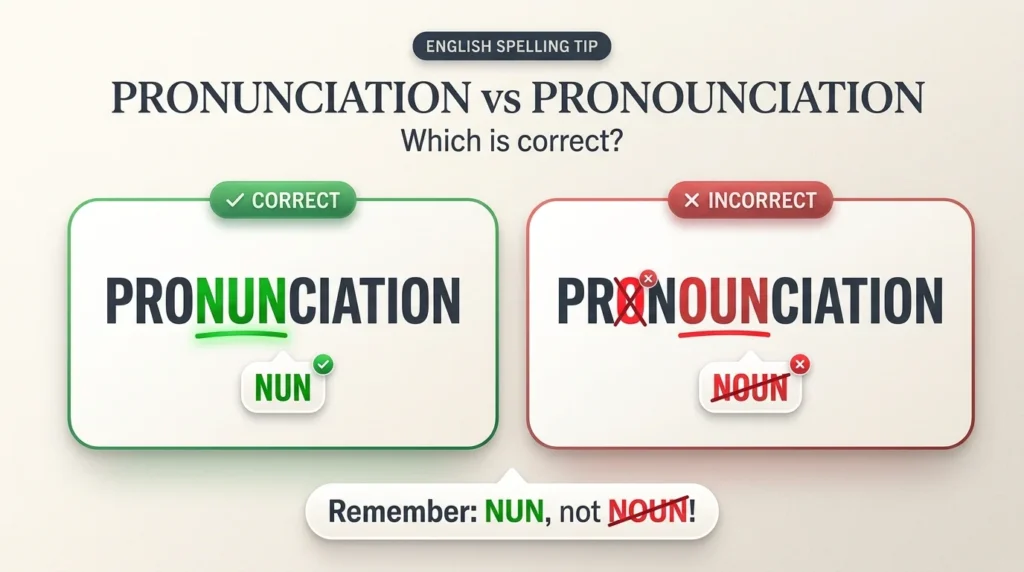

Pronunciation is the correct spelling in standard English. Pronounciation is a common misspelling and is not accepted as the standard spelling. The confusion happens because the word comes from pronounce, which contains an extra “o” sound in its spelling pattern. However, the noun is formed as pronunciation, not pronounciation. Use “pronunciation” when discussing how a word is spoken.
What Pronunciation and Pronounciation Mean
Pronunciation
Pronunciation is a noun that refers to the way a word, sound, or language is spoken.
It describes how someone produces speech, including the sounds, syllables, and stress used when speaking.
Examples:
- Her English pronunciation has improved significantly.
- The teacher explained the pronunciation of the difficult word.
- I checked the pronunciation before using the word in my presentation.
Pronounciation
Pronounciation is a misspelling of pronunciation in modern standard English.
It is not an alternative spelling that should be used in professional writing, academic assignments, emails, or everyday communication.
The mistake usually happens because people try to preserve the spelling of the verb pronounce when writing its related noun.
The Main Difference
The difference is spelling correctness, not meaning.
| Word | Status | Explanation |
|---|---|---|
| Pronunciation | Correct | Standard English noun |
| Pronounciation | Incorrect | Common misspelling |
Both forms are intended to refer to the way words are spoken, but only pronunciation is the standard modern spelling.
For example:
- Correct: I need to improve my English pronunciation.
- Incorrect: I need to improve my English pronounciation.
Also Read: Evoke vs Invoke
The Core Rule
The Rule in Simple English
Remember this spelling:
PRO-NUN-CI-A-TION
Not:
PRO-NOUN-CI-A-TION
The correct noun contains the letters N-U-N, not N-O-U-N.
Why the Rule Works
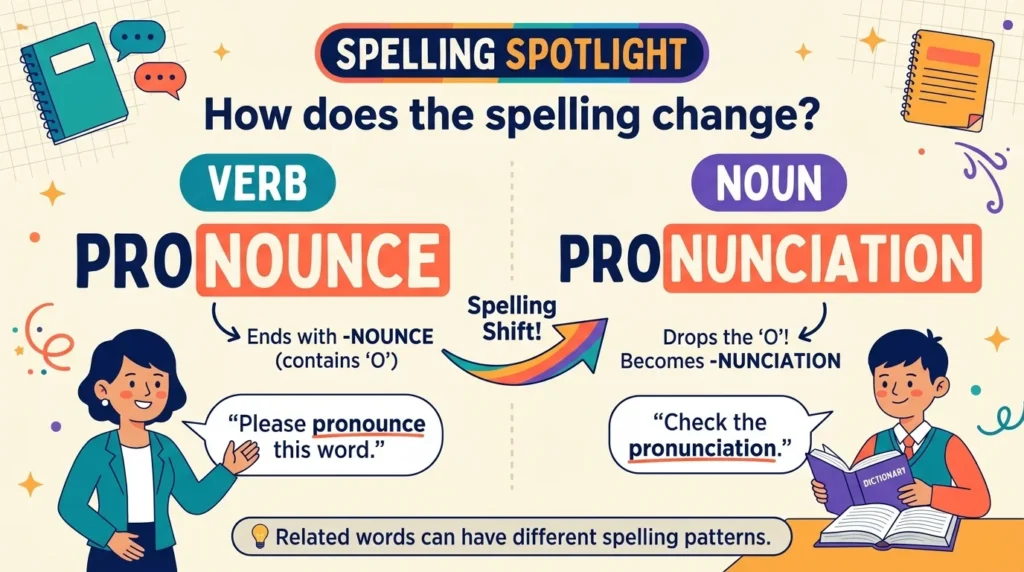
The confusion comes from the related verb pronounce.
Compare the two forms:
| Verb | Noun |
|---|---|
| Pronounce | Pronunciation |
| Pronouncing | Pronunciation |
| Pronounced | Pronunciation |
The verb contains -nounce, but the noun uses -nunciation.
This is an example of a spelling change within a related word family. English does not always preserve the exact spelling of a base word when forming related words.
The important point is that you should learn pronunciation as its own standard spelling rather than automatically copying the spelling of pronounce.
How to Use It
Common Usage
Use pronunciation when discussing:
- How a particular word is spoken.
- The way someone speaks a language.
- Correct or incorrect speech sounds.
- Differences between spoken accents.
- Language-learning exercises.
- The pronunciation of names and unfamiliar vocabulary.
Examples:
- Correct pronunciation is important when learning a new language.
- Her pronunciation of difficult English words is impressive.
- The dictionary provides British and American pronunciation.
- We practised the pronunciation of unfamiliar vocabulary.
Less Common or Special Usage
Pronunciation can also describe a particular way of saying a word.
It can be both countable and uncountable, depending on the sentence.
Uncountable:
- His pronunciation needs improvement.
- Good pronunciation makes speech easier to understand.
Countable:
- The word has two accepted pronunciations.
- Different pronunciations exist across English-speaking regions.
Its plural form is pronunciations, not pronounciations.
Correct Examples
Here are 12 examples showing how to use the correct spelling naturally.
- My English pronunciation has improved through regular speaking practice.
- The teacher corrected my pronunciation during the lesson.
- You can listen to the correct pronunciation in an online dictionary.
- Her pronunciation is clear and easy to understand.
- I am learning the pronunciation of commonly used English words.
- The student struggled with the pronunciation of unfamiliar vocabulary.
- Please check the pronunciation of this name before the interview.
- Different regions may have different pronunciations of the same word.
- Good pronunciation can make professional communication clearer.
- The language course includes pronunciation exercises.
- I sometimes confuse the spelling and pronunciation of English words.
- The presenter practised the pronunciation of technical terms before the meeting.
Incorrect vs Correct
The following examples demonstrate how to correct the common spelling mistake.
| ❌ Incorrect | ✅ Correct | Why |
|---|---|---|
| Pronounciation | Pronunciation | Extra O is incorrect |
| Pronounciations | Pronunciations | Correct plural spelling |
| English pronounciation | English pronunciation | Standard noun spelling |
| Correct pronounciation | Correct pronunciation | Extra O must be removed |
| Improve your pronounciation | Improve your pronunciation | Correct noun form |
| Good pronounciation | Good pronunciation | Standard spelling |
| British pronounciation | British pronunciation | Correct spelling |
| American pronounciation | American pronunciation | Correct spelling |
| Pronounciation guide | Pronunciation guide | Correct compound phrase |
| Pronounciation practice | Pronunciation practice | Correct noun spelling |
For more helpful explanations, check out our guide to commonly confused English words.
Why People Make This Mistake
There are several understandable reasons why people write pronounciation instead of pronunciation.
1. Influence of the verb pronounce
The biggest reason is the spelling of pronounce.
People see the word pronounce and naturally assume that its noun form should retain the same letters.
However:
- Pronounce = verb
- Pronunciation = noun
2. Visual similarity
The two spellings look almost identical. The only difference is the extra letter O in the incorrect version.
When writing quickly, this difference is easy to overlook.
3. Confusion between spelling and sound
The verb pronounce has a different vowel sound in its stressed syllable from the noun pronunciation.
The verb is commonly pronounced /prəˈnaʊns/, while the noun is pronounced /prəˌnʌn.siˈeɪ.ʃən/.
This sound difference helps explain why the noun does not retain the same spelling pattern.
4. Incorrect word-formation assumptions
English learners sometimes expect related words to follow one consistent spelling pattern.
However, related words can undergo spelling and sound changes. Pronunciation is one example.
Common Mistakes
Mistake 1 — Copying the Spelling of Pronounce
A common assumption is that because pronounce contains O, pronounciation must also contain O.
Incorrect: Her pronounciation is excellent.
Correct: Her pronunciation is excellent.
Remember that the verb and noun have different spellings.
Mistake 2 — Using the Incorrect Plural
Adding an S to the incorrect form does not make it correct.
Incorrect: There are several different pronounciations of this word.
Correct: There are several different pronunciations of this word.
Mistake 3 — Confusing Pronunciation With Pronounce
These words have different grammatical functions.
- Pronounce is an action.
- Pronunciation is the way something is spoken.
Correct examples:
- Please pronounce this word.
- Please check the pronunciation of this word.
Pronunciation vs Pronounciation in Real English
In modern standard English, pronunciation is the accepted spelling.
Pronounciation is a recognizable spelling error, not a standard alternative.
There is an interesting historical qualification: the spelling pronounciation has appeared in older English, but that does not make it an acceptable alternative in contemporary standard writing.
In everyday communication, readers will generally understand what someone means when they see the misspelling. However, understanding a mistake does not make it correct.
For professional communication, education, academic writing, and published content, always use pronunciation.
Also Read: Curb vs Kerb
Comparison Table
| Feature | Pronunciation | Pronounciation |
|---|---|---|
| Correctness | Correct | Incorrect in modern standard English |
| Part of speech | Noun | Misspelling of a noun |
| Meaning | Way of speaking words | Intended same meaning |
| Spelling | P-R-O-N-U-N-C-I-A-T-I-O-N | Contains an extra O |
| Usage | Standard English | Avoid |
| Plural | Pronunciations | Pronounciations is incorrect |
| Formal writing | Acceptable | Not acceptable |
| Example | Her pronunciation is clear. | Her pronounciation is clear. |
Memory Trick
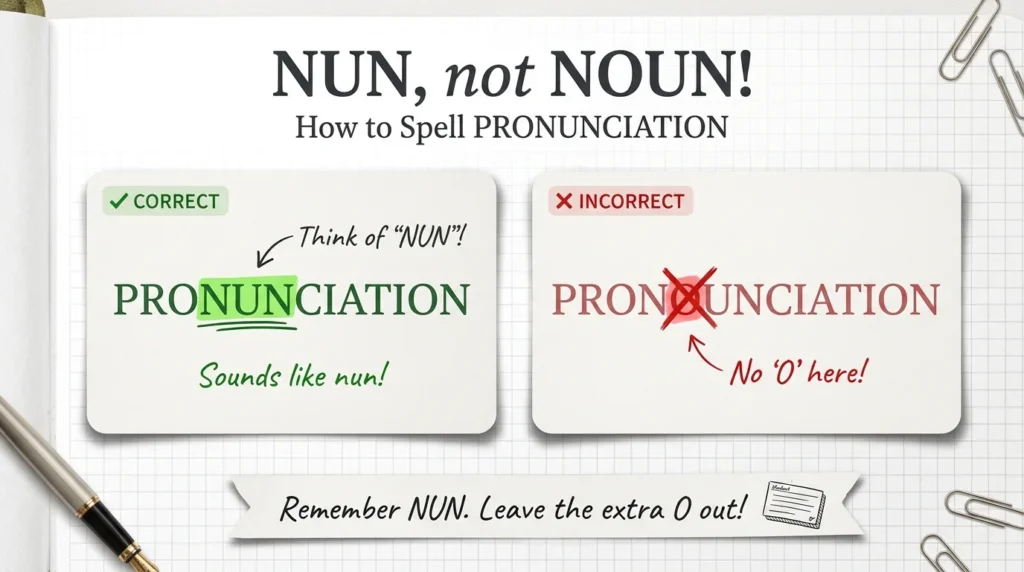
Remember: NUN, not NOUN!
NUN
PRO-NUN-CIATION
Correct
NOUN
PRO-NOUN-CIATION
Incorrect
Easy reminder: When writing the noun, remember NUN. Leave the extra O out!
Real-Life Examples
At Work
Correct: The manager asked everyone to improve their English pronunciation before the international presentation.
Incorrect: The manager asked everyone to improve their English pronounciation.
In an Email
Correct: Could you please confirm the pronunciation of the client’s name before the meeting?
Incorrect: Could you please confirm the pronounciation of the client’s name?
In Conversation
Correct: How do you pronounce this word?
Correct: What is the correct pronunciation of this word?
These sentences demonstrate the difference between the verb and the noun.
At School or University
Correct: Our English teacher assigned a pronunciation exercise for the next class.
Incorrect: Our English teacher assigned a pronounciation exercise for the next class.
Expert Tips
- Memorize the noun separately: Learn pronunciation rather than assuming it follows the spelling of pronounce.
- Remember the NUN pattern: The correct word contains NUN, not NOUN.
- Check the noun when writing: If you are discussing how a word sounds, you need pronunciation.
- Learn related forms together: Practise pronounce, pronounced, pronouncing, and pronunciation as a word family.
- Check the plural carefully: The correct plural is pronunciations.
- Use spellcheck as a final check: Some typing habits can introduce this mistake even when you know the correct spelling.
For more helpful explanations, check out our guide to Commonly Confused English words.
Quick Summary
The correct spelling is pronunciation, not pronounciation. Both forms are intended to refer to how a word or language is spoken, but only pronunciation is the standard modern English spelling. The confusion occurs because the related verb pronounce contains the letters O-U, leading writers to mistakenly carry that spelling into the noun. However, the noun uses N-U-N instead. Remember the simple pattern: PRO-NUN-CI-A-TION. Its plural is pronunciations. Whether you are writing an academic assignment, professional email, presentation, or social media post, always use pronunciation. Learning the noun separately from its related verb is the easiest way to avoid this recurring spelling mistake.
Frequently Asked Questions
1. Is pronunciation or pronounciation correct?
Pronunciation is correct. Pronounciation is a common misspelling and should not be used in modern standard English.
2. Why is pronunciation spelled differently from pronounce?
The related words have different spelling patterns. Pronounce contains O-U, while pronunciation uses U without the additional O. English word formation does not always preserve identical spelling across related forms.
3. Is pronounciation ever correct?
It has historical attestations as an older spelling, but it is not an accepted alternative in contemporary standard English. Use pronunciation.
4. What is the plural of pronunciation?
The correct plural is pronunciations.
Example: Both pronunciations are acceptable in this context.
5. Is pronunciation a noun or a verb?
Pronunciation is a noun. The related verb is pronounce.
Example: Please pronounce the word clearly.
6. How do you pronounce pronunciation?
It is commonly pronounced /prəˌnʌn.siˈeɪ.ʃən/.
A helpful approximation is: pruh-NUN-see-AY-shun.
7. Is there a difference between British and American pronunciation spelling?
No. Both British and American English use the same spelling: pronunciation.
8. How can I remember the correct spelling?
Remember NUN, not NOUN. The noun is spelled pronunciation, with no extra O after the N.
9. Is pronunciation countable or uncountable?
It can be both.
- Uncountable: Her pronunciation is excellent.
- Countable: This word has two pronunciations.
10. What is the difference between pronounce and pronunciation?
Pronounce is a verb describing the act of saying a word. Pronunciation is a noun describing how that word or sound is spoken.
Example:
- Please pronounce this word.
- Your pronunciation is correct.
If you want to learn about another commonly confused pair of English words, check out our guide to Pronunciation vs Pronounciation
Mini Quiz
Test your understanding of the difference between pronunciation and pronounciation.
| # | Question | Answer | Explanation |
|---|---|---|---|
| 1 | Choose the correct spelling: pronunciation / pronounciation | Pronunciation | The noun does not contain the extra O. |
| 2 | Her English ______ is improving. | Pronunciation | A noun is needed to describe how she speaks. |
| 3 | Is pronounciation correct in modern standard English? | No | It is a misspelling. |
| 4 | What is the plural of pronunciation? | Pronunciations | Add S to the correct noun. |
| 5 | Which is the verb: pronounce or pronunciation? | Pronounce | Pronounce describes an action. |
| 6 | Correct this sentence: I like your pronounciation. | I like your pronunciation. | Remove the extra O. |
| 7 | Does British English use pronounciation? | No | Both British and American English use pronunciation. |
| 8 | Choose the correct phrase: pronunciation guide / pronounciation guide | Pronunciation guide | The standard spelling is pronunciation. |
| 9 | Complete the spelling: PRO-NUN-CI-A-TION or PRO-NOUN-CI-A-TION. | PRO-NUN-CI-A-TION | Remember NUN, not NOUN. |
| 10 | Is pronunciation countable or uncountable? | Both | It can refer to pronunciation generally or individual ways of saying a word. |