


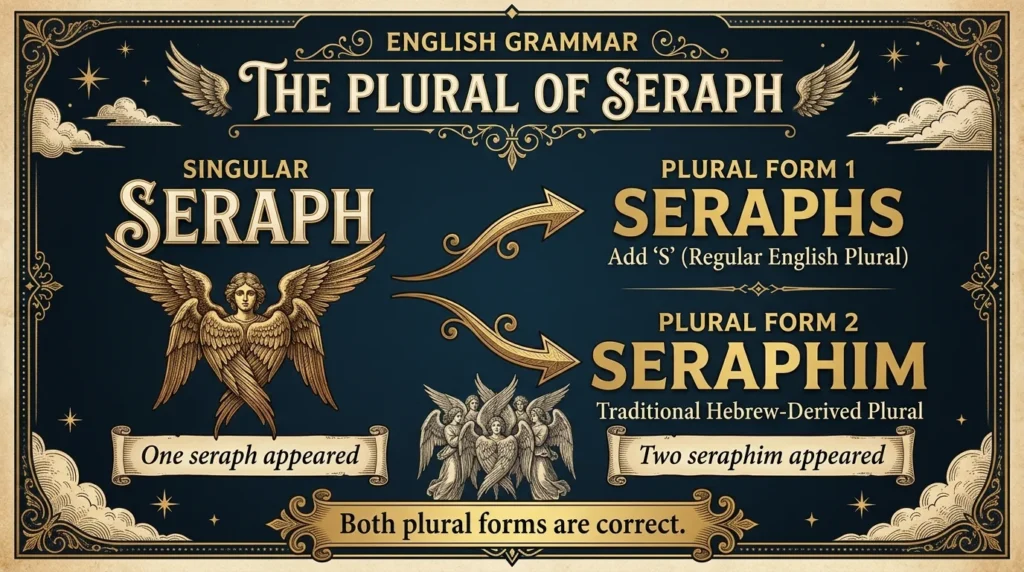
Seraphs and seraphim are both correct plural forms of seraph, a type of angel traditionally described as belonging to the highest order of angels. The main difference is their word formation: seraphs follows the regular English plural pattern by adding -s, while seraphim preserves the traditional Hebrew-derived plural form. Both are accepted in English, but seraphim is especially common in religious, biblical, and theological contexts.
What Seraphs and Seraphim Mean
Both words refer to more than one seraph. A seraph is a heavenly being associated with the presence and worship of God, particularly in the biblical vision described in Isaiah 6.
Seraphs
Seraphs is the regular English plural of seraph. It follows the familiar grammatical rule of adding -s to a singular noun.
Examples:
- The seraphs appeared in the ancient religious illustration.
- The poet described the seraphs as radiant heavenly beings.
- Artists depicted the seraphs with magnificent wings.
- The story describes a choir of seraphs surrounding a heavenly throne.
It is a correct plural form and can be used in general, literary, and religious writing.
Seraphim
Seraphim is the traditional Hebrew-derived plural of seraph. It is commonly used in biblical, religious, and theological writing.
Examples:
- The seraphim surround the heavenly throne.
- The prophet described the seraphim in his vision.
- The painting portrays two magnificent seraphim.
- The seraphim are traditionally associated with six wings.
Unlike regular English plurals, seraphim does not require an additional -s to indicate plurality.
The Main Difference
The difference between seraphs and seraphim is primarily grammatical and stylistic, not a difference in the type of angel being described.
- Seraphs: The regular English plural form of seraph.
- Seraphim: The traditional Hebrew-derived plural form of seraph.
Both forms refer to multiple seraphs. Neither represents a different category of angel.
| Seraphs | Seraphim |
|---|---|
| Regular English plural | Traditional Hebrew-derived plural |
| Formed by adding -s | Retains the traditional plural ending |
| Common in general and literary English | Common in biblical and theological writing |
| Correct and accepted | Correct and accepted |
| Example: The seraphs appeared. | Example: The seraphim appeared. |
Also Read: Peoples vs People
The Core Rule
The Rule in Simple English
Use seraphs or seraphim when referring to more than one seraph.
Both are grammatically correct.
- One seraph
- Two seraphs
- Two seraphim
The choice depends mainly on writing style and context.
Why the Rule Works
English contains nouns borrowed from other languages that sometimes retain their original plural forms.
For example:
| Singular | Traditional plural |
|---|---|
| Seraph | Seraphim |
| Cherub | Cherubim |
| Datum | Data |
| Phenomenon | Phenomena |
| Criterion | Criteria |
However, some borrowed nouns also develop regular English plurals.
Seraph has both forms:
- Seraph → Seraphs
- Seraph → Seraphim
The traditional form reflects its Hebrew linguistic background, while seraphs follows ordinary English plural formation.
How to Use It
Common Usage
Use seraphs when you want a straightforward English plural, particularly in general or literary writing.
Examples:
- The author described the seraphs as beautiful creatures.
- The illustration showed several seraphs with glowing wings.
- The fictional story introduced three seraphs.
Use seraphim when discussing biblical descriptions, religious traditions, or theological concepts.
Examples:
- The seraphim are described in Isaiah’s vision.
- The choir of seraphim symbolizes heavenly worship.
- The ancient text refers to the seraphim surrounding the divine throne.
Less Common or Special Usage
Seraphim is also used in poetry, classical literature, and artistic descriptions to create a traditional or elevated religious tone.
For example:
- The poet imagined the seraphim singing among the stars.
- The cathedral ceiling featured magnificent paintings of seraphim.
This does not mean seraphs is informal or incorrect. Both forms are acceptable.
Correct Examples
- The ancient manuscript describes the seraphim surrounding the heavenly throne.
- The artist painted several seraphs with magnificent wings.
- The prophet’s vision included powerful seraphim.
- The poem compares the heavenly beings to radiant seraphs.
- The cathedral contains beautiful images of seraphim.
- The author described the seraphs as guardians of divine glory.
- The religious illustration depicts two seraphim above the throne.
- The story introduces three seraphs in a celestial setting.
- The theologian discussed the role of seraphim in angelic traditions.
- The painting portrays the seraphs with six wings.
- The choir of seraphim symbolizes heavenly worship.
- The writer used the word seraphs to describe multiple heavenly beings.
Incorrect vs Correct
| Incorrect | Correct | Why |
|---|---|---|
| The seraphim are beautiful angels. (Incorrectly marked as wrong) | The seraphim are beautiful angels. | Seraphim is a correct plural. |
| The seraphs are heavenly beings. (Incorrectly marked as wrong) | The seraphs are heavenly beings. | Seraphs is also a correct plural. |
| Two seraphims appeared. | Two seraphim appeared. | Seraphim is already plural. |
| One seraphim appeared. | One seraph appeared. | Seraph is the singular form. |
| A seraphs appeared. | A seraph appeared. | Singular nouns take a singular article. |
| Three seraph appeared. | Three seraphs appeared. | Seraphs is the regular plural. |
| One seraphs was mentioned. | One seraph was mentioned. | Use the singular form after one. |
| Several seraphim was described. | Several seraphim were described. | Seraphim takes a plural verb. |
| The seraphims were singing. | The seraphim were singing. | Avoid adding another plural ending. |
| Many seraph was depicted. | Many seraphs were depicted. | Many requires a plural noun. |
Important: The first two examples demonstrate valid forms that should not be mistaken for grammatical errors. The correction is about understanding that both plurals are acceptable.
For more helpful explanations, check out our guide to commonly confused English words.
Why People Make This Mistake
There are three main reasons.
1. Confusion between English and traditional plurals
Most English learners expect plural nouns to end in -s or -es. However, words borrowed from Hebrew, Greek, and Latin sometimes retain traditional plural forms.
For example:
- Seraph → Seraphim
- Cherub → Cherubim
- Criterion → Criteria
This makes seraphim look unusual to people unfamiliar with traditional plural patterns.
2. Assuming seraphim is singular
Because seraphim does not end in -s, some learners mistakenly treat it as a singular noun.
However, seraphim is already plural. Its singular form is seraph.
3. Confusing seraphim with seraphims
Learners sometimes add another -s to seraphim because they recognize it as a plural but apply the regular English plural rule again.
In standard English, use seraphs or seraphim, not seraphims.
Common Mistakes
Mistake 1: Treating Seraphim as Singular
Incorrect: One seraphim appeared in the painting.
Correct: One seraph appeared in the painting.
Seraphim is the traditional plural, not the singular form.
Mistake 2: Adding an Extra S
Incorrect: The seraphims surrounded the throne.
Correct: The seraphim surrounded the throne.
The word already carries its plural meaning.
Mistake 3: Assuming Seraphs Is Wrong
Incorrect assumption: Seraphim is the only acceptable plural.
Correct understanding: Both seraphs and seraphim are accepted English plurals.
Mistake 4: Mixing Singular and Plural Verb Forms
Incorrect: The seraphim was described in the text.
Correct: The seraphim were described in the text.
When seraphim refers to multiple beings, it takes a plural verb.
Seraphs vs Seraphim in Real English
Both forms are correct, but their usage can differ depending on context.
| Context | Natural choice |
|---|---|
| General English | Seraphs or seraphim |
| Biblical discussion | Seraphim |
| Christian theology | Seraphim |
| Religious literature | Seraphim |
| General literary writing | Both |
| Poetry | Both |
| Fiction and fantasy | Both |
| Academic discussion of angelology | Usually seraphim |
Seraphim is particularly familiar in religious writing because of its traditional connection with Hebrew and biblical terminology.
Seraphs is a straightforward English alternative that is also recognized by major dictionaries.
The choice does not change the basic meaning.
Also Read: Stadiums vs Stadia
Comparison Table
| Feature | Seraphs | Seraphim |
|---|---|---|
| Singular | Seraph | Seraph |
| Grammatical form | Plural noun | Plural noun |
| Formation | Regular English plural | Hebrew-derived plural |
| Meaning | Multiple seraphs | Multiple seraphs |
| Correctness | Correct | Correct |
| Religious usage | Accepted | Especially established |
| Literary usage | Accepted | Accepted |
| Example | The seraphs appeared. | The seraphim appeared. |
Memory Trick
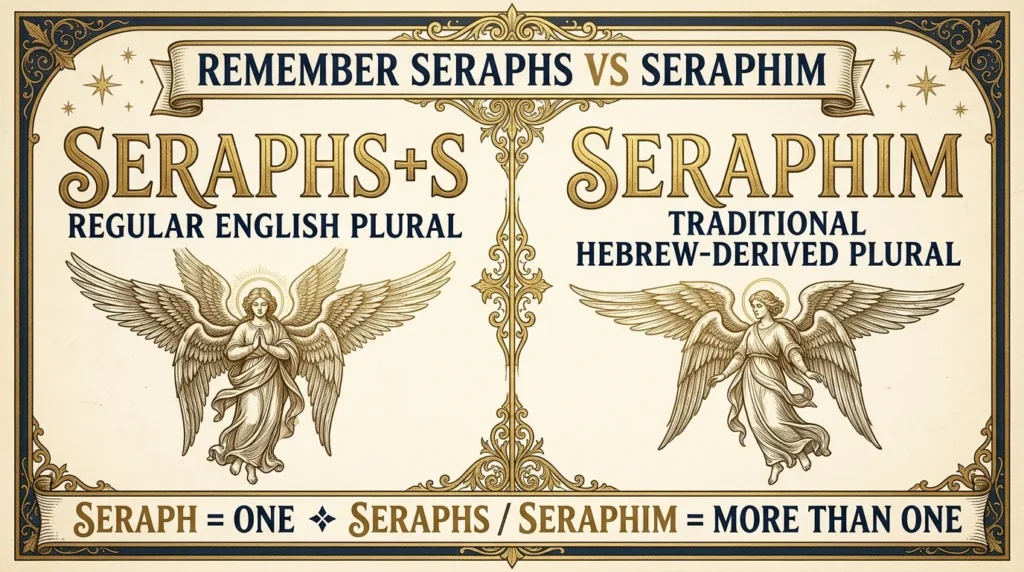
Remember this simple distinction:
SERAPHS
Seraph + S = Regular English plural
Think of the normal English plural rule.
SERAPHIM
Traditional Hebrew-derived plural
Remember the traditional biblical form.
Quick memory rule: Seraphs = regular plural. Seraphim = traditional plural.
Both mean more than one seraph.
Real-Life Examples
In Religious Writing
- The seraphim are traditionally associated with the worship of God.
- The biblical vision describes heavenly beings surrounding the throne.
In an Email or Academic Discussion
- Our research examines the representation of seraphim in religious art.
- The paper compares different artistic depictions of seraphs.
In Literature
- The poet described the seraphs as shining figures in the heavens.
- The story portrayed the seraphim as guardians of divine glory.
In Conversation
- Is seraphim the plural of seraph?
- Yes, although seraphs is also an accepted plural form.
Expert Tips
- Remember that seraph is the singular form.
- Use seraphs for the regular English plural.
- Use seraphim for the traditional Hebrew-derived plural.
- Do not add another -s to seraphim in standard English.
- Use plural verbs with seraphim when referring to multiple beings.
- Do not assume that one plural form is incorrect simply because the other is more familiar in religious writing.
- Remember the similar pattern in cherub and cherubim.
For more helpful explanations, check out our guide to Commonly Confused English words.
Quick Summary
Seraphs and seraphim are both accepted plural forms of seraph, a heavenly being traditionally associated with the highest order of angels. Seraphs follows the regular English plural rule by adding -s, whereas seraphim retains a traditional Hebrew-derived plural form. Both words refer to the same type of heavenly being and do not represent different categories of angels. Seraphim is particularly common in biblical, theological, and religious contexts, while seraphs is a straightforward English alternative. Remember that the singular is always seraph, and avoid using seraphims in standard English.
Frequently Asked Questions
1. What is the difference between seraphs and seraphim?
Both are plural forms of seraph. Seraphs follows regular English plural formation, while seraphim is the traditional Hebrew-derived plural.
2. Is seraphim the plural of seraph?
Yes. Seraphim is a recognized traditional plural of seraph.
3. Is seraphs grammatically correct?
Yes. Seraphs is the regular English plural and is accepted by major dictionaries.
4. Which is more common: seraphs or seraphim?
Seraphim is particularly established in biblical and religious contexts. Both forms are recognized, and the preferred choice depends on context.
5. What is the singular form of seraphim?
The singular form is seraph.
6. Is seraphims a correct word?
Seraphims is not the standard plural form in contemporary English. Use seraphs or seraphim instead.
7. What does seraph mean?
A seraph is a heavenly being traditionally regarded as belonging to the highest order of angels in Christian angelology.
8. Are seraphs and seraphim different types of angels?
No. They are simply two plural forms of the same noun, seraph.
9. Why does seraphim not end in S?
Because it preserves a traditional Hebrew-derived plural form rather than following the regular English plural pattern.
10. Should I use seraphs or seraphim in academic writing?
Both are acceptable. Seraphim is often a natural choice in biblical studies, theology, and discussions of religious traditions. Follow the terminology used in your academic context.
If you want to learn about another commonly confused pair of English words, check out our guide to Seraphs vs Seraphim
Mini Quiz
Choose the correct answer in each sentence.
| # | Question | Answer | Explanation |
|---|---|---|---|
| 1 | What is the singular of seraphim? (Seraph / Seraphs) | Seraph | Seraph is the singular form. |
| 2 | Which is the regular English plural? (Seraphs / Seraphim) | Seraphs | It adds the regular plural suffix -s. |
| 3 | Which is the traditional Hebrew-derived plural? (Seraphs / Seraphim) | Seraphim | It preserves the traditional plural form. |
| 4 | The ___ surrounded the heavenly throne. (Seraph / Seraphim) | Seraphim | The sentence refers to multiple beings. |
| 5 | Two ___ appeared in the illustration. (Seraphs / Seraph) | Seraphs | Two requires a plural noun. |
| 6 | Is seraphim a singular noun? (Yes / No) | No | Seraphim is plural. |
| 7 | Which form is incorrect in standard English? (Seraphs / Seraphims) | Seraphims | Use seraphs or seraphim. |
| 8 | Both seraphs and seraphim are correct. (True / False) | True | Both are accepted plural forms. |
| 9 | The seraphim ___ described in the ancient text. (Was / Were) | Were | Seraphim takes a plural verb. |
| 10 | Which form is particularly familiar in biblical writing? (Seraphs / Seraphim) | Seraphim | It is the traditional religious form. |



Pingback: Fewer vs Less: Meaning, Difference & Grammar Rules