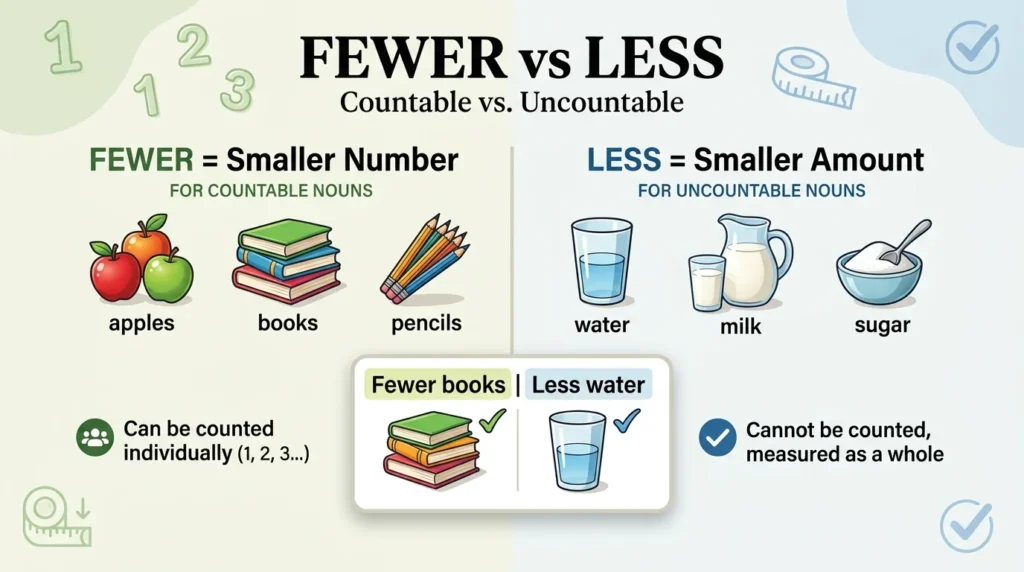

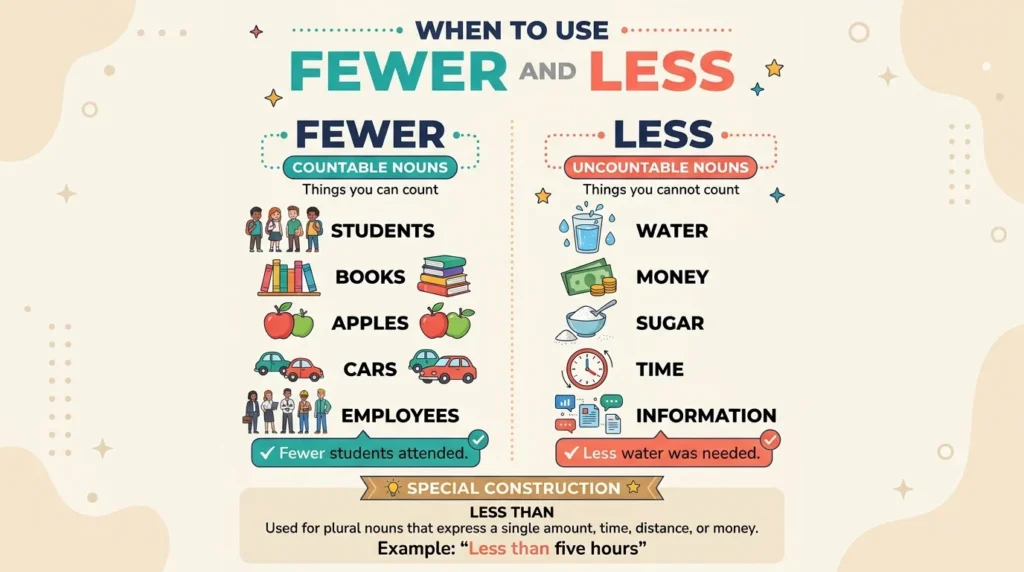
Fewer and less both describe a smaller quantity, but they are used with different types of nouns. Fewer is generally used with countable plural nouns, while less is generally used with uncountable nouns. For example, say “fewer books” because books can be counted, and “less water” because water is measured rather than counted. Understanding this distinction helps you choose the correct word in everyday conversation, academic writing, and professional communication.
What Fewer and Less Mean
Both words express a reduction in quantity or amount, but their grammatical usage differs.
Fewer
Fewer means a smaller number of individual items, people, or things that can be counted separately.
Examples:
- There are fewer students in the classroom today.
- I made fewer mistakes in my latest assignment.
- We need fewer employees for this project.
- She bought fewer books this month.
Use fewer when referring to countable plural nouns.
Less
Less means a smaller amount or quantity of something, especially when the noun cannot normally be counted individually.
Examples:
- I need less sugar in my tea.
- We have less time than expected.
- She spends less money on unnecessary purchases.
- There is less traffic on the road today.
Use less when referring to uncountable nouns or quantities.
The Main Difference
The main difference between fewer and less is whether the noun refers to countable items or an uncountable amount.
- Fewer: A smaller number of countable things.
- Less: A smaller amount of something.
Compare:
| Fewer | Less |
|---|---|
| Fewer apples | Less juice |
| Fewer students | Less education |
| Fewer mistakes | Less information |
| Fewer employees | Less work |
| Fewer cars | Less traffic |
| Fewer questions | Less confusion |
The first column contains countable plural nouns, while the second contains uncountable nouns.
Also Read: Seraphs vs Seraphim
The Core Rule
The Rule in Simple English
Use fewer with countable plural nouns.
Use less with uncountable nouns.
Examples:
- Fewer chairs, not less chairs.
- Less water, not fewer water.
- Fewer customers, not less customers.
- Less time, not fewer time.
Why the Rule Works
English distinguishes between countable and uncountable nouns.
Countable nouns refer to things that can be counted individually.
Examples:
- One apple, two apples.
- One student, three students.
- One book, five books.
Uncountable nouns refer to substances, concepts, or quantities that are not normally counted as individual units.
Examples:
- Water
- Money
- Information
- Advice
- Furniture
- Traffic
This distinction determines whether fewer or less is normally appropriate.
How to Use It
Common Usage of Fewer
Use fewer when comparing the number of individual items, people, or objects.
Examples:
- Fewer people attended the meeting this year.
- The new system produces fewer errors.
- We received fewer applications than expected.
- There are fewer opportunities in this particular market.
Common Usage of Less
Use less when comparing the amount, degree, or extent of something.
Examples:
- I have less free time this week.
- This recipe requires less oil.
- The company has less financial pressure.
- She showed less interest in the discussion.
Special Usage: Less with Countable Nouns
Although the traditional rule favors fewer with countable plural nouns, less is also accepted in certain established expressions and contexts.
Examples:
- The journey takes less than three hours.
- The product costs less than $20.
- There were less than 50 people at the event.
- The temperature dropped to less than five degrees.
In these examples, less than expresses an overall numerical quantity, measurement, or amount.
Other common examples include:
- Less than 10 kilometers.
- Less than 100 dollars.
- Less than five kilograms.
The distinction is important: not every appearance of less before a number is grammatically incorrect.
Correct Examples
- Fewer people are visiting the shopping center this month.
- I need less time to complete this assignment.
- The teacher received fewer questions after the explanation.
- We should spend less money on unnecessary expenses.
- There are fewer opportunities in this industry.
- This machine uses less electricity than the previous model.
- The new policy has resulted in fewer complaints.
- She added less salt to the soup.
- Fewer employees attended the training session.
- I have less information about the new project.
- The company received fewer orders last week.
- He drinks less coffee than he used to.
Incorrect vs Correct
| Incorrect | Correct | Why |
|---|---|---|
| Less students attended the class. | Fewer students attended the class. | Students are countable. |
| Fewer water is needed. | Less water is needed. | Water is uncountable. |
| Less books were available. | Fewer books were available. | Books are countable. |
| Fewer money was spent. | Less money was spent. | Money is uncountable. |
| Less mistakes were made. | Fewer mistakes were made. | Mistakes are countable. |
| Fewer information was provided. | Less information was provided. | Information is uncountable. |
| Less employees were hired. | Fewer employees were hired. | Employees are countable. |
| Fewer traffic was expected. | Less traffic was expected. | Traffic is uncountable. |
| Less apples were purchased. | Fewer apples were purchased. | Apples are countable. |
| Fewer furniture was delivered. | Less furniture was delivered. | Furniture is uncountable. |
Important: These corrections follow the standard countable-versus-uncountable rule. Some informal expressions and special measurement constructions allow less in other contexts.
For more helpful explanations, check out our guide to commonly confused English words.
Why People Make This Mistake
There are three main reasons.
1. Both words express a smaller quantity.
Because fewer and less communicate a similar general idea, people sometimes use them interchangeably.
For example:
- Fewer customers visited the store.
- Less traffic entered the shopping area.
Both describe a reduction, but the nouns determine the appropriate choice.
2. Confusion about countable and uncountable nouns.
Some nouns are difficult to classify because they describe things that can be measured but are not normally counted individually.
For example:
- Information is uncountable.
- Advice is uncountable.
- Furniture is uncountable.
- Equipment is uncountable.
This makes less information and less furniture correct.
3. Everyday expressions influence grammar.
Expressions such as less than 100 people and less than five minutes are common.
People may assume that less is always appropriate before plural countable nouns. However, standard writing generally prefers fewer when directly referring to a number of individual items.
Common Mistakes
Mistake 1: Using Less with Countable Plural Nouns
Incorrect: There are less students in the classroom.
Correct: There are fewer students in the classroom.
Students can be counted individually, so fewer is the standard choice.
Mistake 2: Using Fewer with Uncountable Nouns
Incorrect: I need fewer information about the project.
Correct: I need less information about the project.
Information is an uncountable noun.
Mistake 3: Assuming Less Is Always Wrong with Numbers
Incorrect assumption: Less than 20 people is always grammatically incorrect.
Correct: Less than 20 people attended the meeting.
The expression less than is widely accepted when expressing a numerical limit or total.
Mistake 4: Confusing Amount and Number
Incorrect: We need fewer time to finish the work.
Correct: We need less time to finish the work.
Time is normally uncountable when referring to duration.
Fewer vs Less in Real English
Both words appear frequently in everyday English, but their natural usage depends on the noun and sentence structure.
| Context | Natural choice |
|---|---|
| Counting people | Fewer |
| Counting objects | Fewer |
| Comparing money | Less |
| Comparing time | Less |
| Comparing information | Less |
| Comparing employees | Fewer |
| Comparing mistakes | Fewer |
| Comparing traffic | Less |
| Comparing electricity | Less |
| Expressing a numerical limit | Less than |
In professional and academic writing, following the countable-versus-uncountable distinction is generally the safest approach.
Also Read: Peoples vs People
Comparison Table
| Feature | Fewer | Less |
|---|---|---|
| Basic meaning | Smaller number | Smaller amount |
| Main usage | Countable plural nouns | Uncountable nouns |
| Grammatical category | Determiner or pronoun | Determiner, pronoun or adverb |
| Refers to | Individual items | Amount, degree or extent |
| Everyday usage | Very common | Very common |
| Example | Fewer customers | Less money |
| Special usage | Fewer than 10 people | Less than 10 minutes |
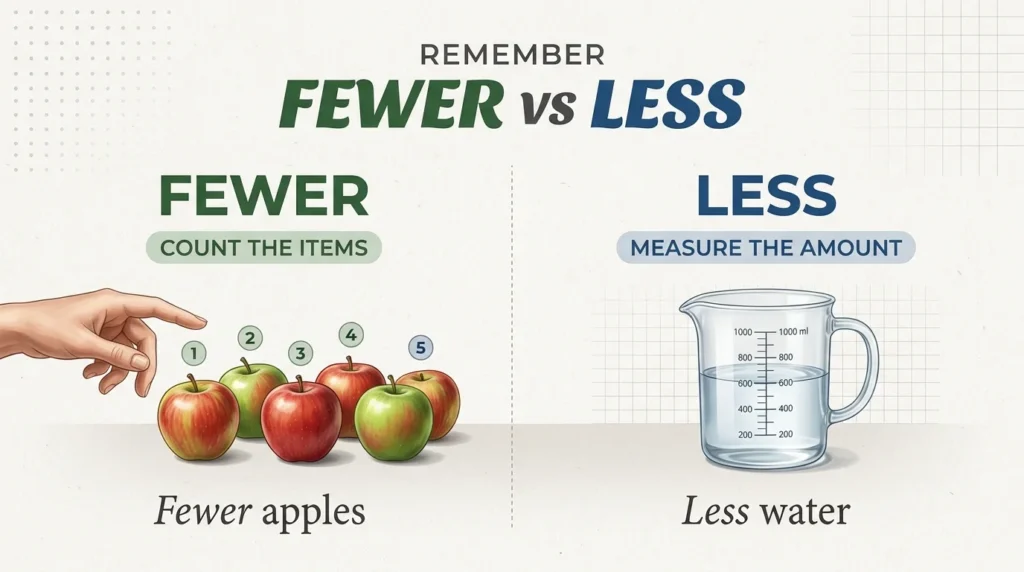
Memory Trick
Remember this simple distinction:
FEWER
Count the items = Fewer
Use it when you can count individual objects or people.
Fewer apples.
LESS
Measure the amount = Less
Use it when referring to an amount or quantity.
Quick memory rule: Fewer = Number. Less = Amount.
Real-Life Examples
At Work
- We received fewer customer complaints this month.
- The department has less work to complete this week.
In an Email
- We need fewer revisions before publishing the report.
- Please provide less unnecessary information in the document.
In Conversation
- I have fewer friends in this city.
- I have less free time these days.
At School or University
- Fewer students participated in the examination.
- We have less time to prepare for the final presentation.
Expert Tips
- Use fewer with countable plural nouns such as books, employees, customers, and mistakes.
- Use less with uncountable nouns such as water, money, information, and furniture.
- Remember that less than is acceptable when expressing numerical limits and measurements.
- Do not assume that every noun ending in S is countable.
- Some nouns can be countable or uncountable depending on their meaning. For example, less chicken refers to less meat, while fewer chickens refers to fewer individual birds.
- In formal writing, prefer fewer people over less people when directly referring to a number of individuals.
For more helpful explanations, check out our guide to Commonly Confused English words.
Quick Summary
Fewer and less both indicate a smaller quantity, but they are generally used with different types of nouns. Fewer is used with countable plural nouns, such as books, students, employees, and customers. Less is used with uncountable nouns, such as water, money, information, and time. For example, say “fewer mistakes” but “less confusion.” Although the traditional rule distinguishes countable numbers from uncountable amounts, expressions such as “less than 20 people” are also accepted in standard English. The easiest way to remember the difference is: fewer refers to a number, while less refers to an amount.
Frequently Asked Questions
1. What is the difference between fewer and less?
Fewer refers to a smaller number of countable items, while less refers to a smaller amount of something, usually uncountable.
2. Is fewer used for countable nouns?
Yes. Fewer is generally used with countable plural nouns, such as books, people, and employees.
3. Is less used for uncountable nouns?
Yes. Less is generally used with uncountable nouns, such as water, money, information, and time.
4. Is less people grammatically correct?
In standard usage, fewer people is preferred because people are countable individuals. However, less people is common in informal speech.
5. Is it fewer money or less money?
Less money is correct because money is normally an uncountable noun.
6. Is it fewer time or less time?
Less time is correct because time, when referring to duration, is uncountable.
7. Can less be used with numbers?
Yes. Expressions such as less than 10 minutes and less than 50 people are widely accepted.
8. Is less than 100 people correct?
Yes. It is a common construction expressing a numerical limit. Fewer than 100 people is also correct and emphasizes the count of individuals.
9. What is the difference between fewer and fewer than?
Fewer describes a smaller number, while fewer than introduces a numerical comparison or limit.
Example: We have fewer employees than last year.
10. What is the easiest way to remember fewer and less?
Remember that fewer is for countable items, while less is for uncountable amounts.
If you want to learn about another commonly confused pair of English words, check out our guide to Fewer vs Less
Mini Quiz
Choose the correct answer in each sentence.
| # | Question | Answer | Explanation |
|---|---|---|---|
| 1 | There are ___ students today. (fewer / less) | Fewer | Students are countable. |
| 2 | I need ___ water. (fewer / less) | Less | Water is uncountable. |
| 3 | She made ___ mistakes. (fewer / less) | Fewer | Mistakes are countable. |
| 4 | We have ___ time. (fewer / less) | Less | Time is uncountable. |
| 5 | The company hired ___ employees. (fewer / less) | Fewer | Employees are countable. |
| 6 | Please add ___ sugar. (fewer / less) | Less | Sugar is uncountable. |
| 7 | I received ___ emails this week. (fewer / less) | Fewer | Emails are countable. |
| 8 | There is ___ traffic today. (fewer / less) | Less | Traffic is uncountable. |
| 9 | We spent ___ money this month. (fewer / less) | Less | Money is uncountable. |
| 10 | ___ than 20 people attended. (Fewer / Less) | Both | Both constructions are accepted. |

