


Sore and soar sound the same in standard English, but they have different meanings and grammatical roles. Sore usually describes pain, tenderness, or irritation, as in “My legs are sore.” Soar is a verb meaning to fly or rise high, and it can also mean to increase rapidly, as in “The eagle soared” or “Prices soared.”
What Sore vs Soar Means
Sore and soar are homophones: words that have the same pronunciation but different spellings and meanings. This is why the pair can be confusing in writing. When someone says either word aloud, the sound alone usually does not tell you which spelling they mean. You have to use the surrounding context.
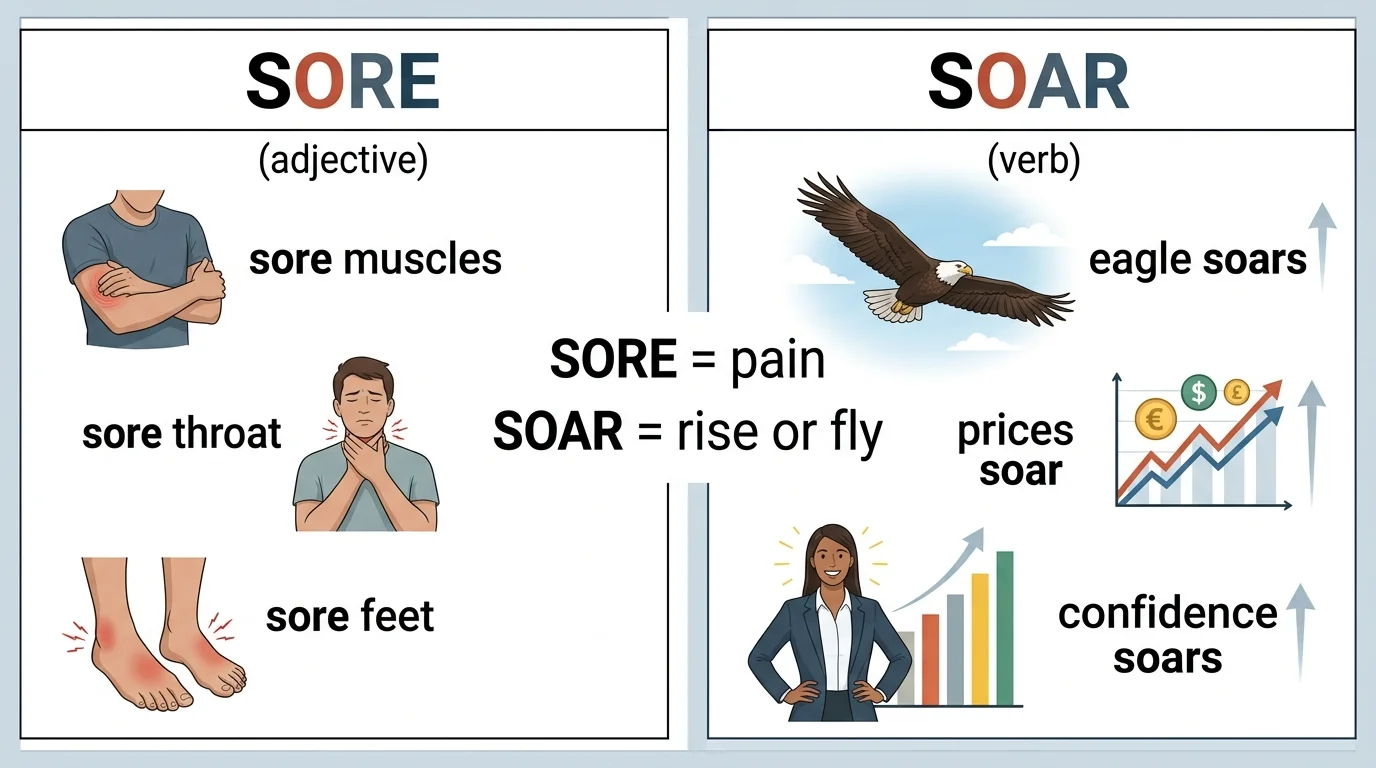
Sore is most commonly an adjective describing something painful, tender, or uncomfortable. It is often used for parts of the body or muscles after exercise, excessive use, injury, or irritation. Common expressions include sore throat, sore muscles, sore feet, sore back, and sore eyes. “My shoulders are sore after moving the furniture” means the shoulders feel painful or tender.
Soar, in contrast, is a verb. Its literal meaning involves rising or flying high in the air. An eagle can soar above a valley, and a kite can soar over a field. The word also has an important figurative use: something such as prices, costs, temperatures, sales, hopes, or confidence can soar when it rises rapidly or dramatically.
There is also more to sore than physical pain. As an adjective, especially in American informal English, it can describe someone who is angry or upset because they feel unfairly treated. That is the meaning behind expressions such as sore loser. As a noun, sore can mean a painful area on the body, particularly one associated with a wound or infection.
So the quickest distinction is:
- Sore = painful, tender, irritated, or upset
- Soar = fly high, rise high, or increase rapidly
The Main Difference
The central difference between sore and soar is meaning and grammatical function, not pronunciation.
| Word | Main role | Core idea | Example |
|---|---|---|---|
| sore | Adjective; also noun | Pain, tenderness, irritation, or upset | My legs are sore. |
| soar | Verb | Fly high, rise, or increase rapidly | Prices soared. |
Think about what the sentence is describing.
If it describes a condition or feeling of pain, sore is usually the correct word:
My feet are sore after the hike.
If it describes an action of rising or flying, use soar:
The hawk soared above the trees.
If it describes a rapid increase, use soar again:
Housing costs have soared.
This distinction is especially important because both spellings can look perfectly reasonable when you only think about their sound. A spellchecker may not catch the mistake either. Sore and soar are both legitimate English words, so software may accept either one even when only one makes sense in the sentence.
Compare these two sentences:
My arms are sore after the workout.
The bird began to soar above the lake.
The pronunciation is essentially the same, but the meanings are completely different. The first describes physical discomfort. The second describes movement through the air.
The Core Rule
The Rule in Simple English
Use sore when the idea is pain, tenderness, irritation, or certain kinds of emotional upset.
Use soar when the idea is flying high, rising high, or increasing very quickly.
A simple decision rule is:
If it hurts, think “sore.”
If it goes up, think “soar.”
For example:
- My neck is sore. → It hurts.
- She has a sore throat. → Her throat is painful or irritated.
- The eagle will soar. → It will fly high.
- Temperatures soared. → They increased rapidly.
- His confidence soared. → His confidence increased greatly.
This rule handles most everyday uses of the two words.
Why the Rule Works
The distinction works because the two words developed as separate vocabulary items with different meanings and grammatical behavior. Their shared pronunciation does not make them interchangeable.
Sore commonly functions as an adjective:
Her shoulder is sore.
It describes the condition of her shoulder.
It can also appear before a noun:
She has a sore shoulder.
Soar functions as a verb:
The eagle soared across the canyon.
It tells us what the eagle did.
It can also describe a change in level or amount:
Food prices soared during the shortage.
In that sentence, soared means that prices rose sharply.
The grammar therefore provides another useful clue. If you need a word that describes a painful condition, think sore. If you need a verb showing that something rises or flies, think soar.
How to Use It
Common Usage
The most common everyday use of sore is to describe physical discomfort.
You can say:
- a sore throat
- sore muscles
- a sore knee
- sore feet
- a sore back
- sore eyes
- a sore shoulder
You can also use sore after linking verbs:
My legs feel sore.
Her ankle is sore.
His shoulders became sore after carrying the boxes.
The word does not always mean severe pain. It can describe an area that is tender, uncomfortable, irritated, or painful because it has been overused or affected by another condition.
Sore also has emotional uses:
He is still sore about losing the competition.
Here, sore means angry or upset rather than physically painful. In American English, this use is commonly associated with informal expressions such as sore loser.
As a noun, sore refers to a painful area or wound:
The doctor examined the sore on his hand.
That noun use is different from the adjective use, but it still connects to the basic idea of pain or an affected area.
Soar is commonly used for birds and other things moving high through the air:
The eagle soared over the mountains.
It can also be used more broadly for something that rises dramatically:
The temperature soared in the afternoon.
Demand for the product soared.
Her confidence soared after the successful presentation.
The figurative use is important because soar does not always involve physical movement. A number, feeling, level, cost, or amount can soar when it rises quickly or substantially.
Less Common or Special Usage
One useful point is that sore is not limited to physical pain.
For example:
That subject is still a sore point for him.
Here, sore refers to something emotionally sensitive or difficult.
Similarly:
She was sore about the decision.
In this context, sore means upset or angry.
Soar also has a broader figurative range than simply “fly.” You may encounter it with abstract subjects:
- hopes soar
- spirits soar
- confidence soars
- demand soars
- costs soar
- prices soar
- sales soar
The underlying idea remains the same: something is moving upward, either literally or figuratively.
Correct Examples
Here are natural examples showing the difference in context:
- My legs are sore after yesterday’s football practice.
Here, sore describes physical discomfort. - She woke up with a sore throat.
Her throat is painful or irritated. - His shoulders became sore after carrying the boxes upstairs.
The shoulders feel painful after being heavily used. - My feet were sore after walking around the city all afternoon.
The feet became uncomfortable from prolonged walking. - The hawk soared above the open fields.
The hawk flew high through the air. - The kite soared above the rooftops in the strong wind.
The kite moved high through the air. - Temperatures soared during the hottest part of the afternoon.
The temperatures rose rapidly. - The company’s online sales soared after the new product launched.
Sales increased dramatically. - Her confidence soared when she received positive feedback.
Her confidence increased greatly. - He was still sore about the way the meeting ended.
Here, sore means upset or angry rather than physically painful. - The runner’s knees were sore after the long race.
Sore describes physical discomfort. - The eagle continued to soar despite the strong wind.
Soar describes high flight. - Fuel costs have soared over the past year.
Soared means increased sharply. - The child complained that his eyes were sore after staring at the screen.
Sore describes irritation or discomfort. - Their hopes soared when they heard the good news.
Soared describes a strong increase in hope.
Incorrect vs Correct
| ❌ Incorrect | ✅ Correct | Why |
|---|---|---|
| My legs are soar after the workout. | My legs are sore after the workout. | The legs are painful or tender. |
| I have a soar throat. | I have a sore throat. | A painful or irritated throat is a sore throat. |
| Her back feels soar today. | Her back feels sore today. | Sore describes physical discomfort. |
| My feet became soar after the hike. | My feet became sore after the hike. | The feet hurt after walking. |
| The eagle began to sore above the valley. | The eagle began to soar above the valley. | The verb for flying high is soar. |
| The hawk sored over the trees. | The hawk soared over the trees. | The past tense of soar is soared. |
| Prices are expected to sore this winter. | Prices are expected to soar this winter. | Soar can mean increase rapidly. |
| Sales have sore since the campaign started. | Sales have soared since the campaign started. | The past participle of soar is soared. |
| The bird is soar above us. | The bird is soaring above us. | After “is” for an action in progress, use soaring. |
| The temperature sored to a record level. | The temperature soared to a record level. | Soared is the correct past-tense form. |
| His muscles were soar after training. | His muscles were sore after training. | The muscles are painful or tender. |
| Her confidence sored after the interview. | Her confidence soared after the interview. | Soared means increased greatly. |
The important point is that the “incorrect” spelling is not necessarily an invented or meaningless word. Sore and soar are both real words. The problem is using the correct English word in the wrong context.
Why People Make This Mistake
The biggest reason is pronunciation.
In standard English, sore and soar are pronounced the same in the common UK and US pronunciations shown by major learner dictionaries.
That creates a special problem when listening. Imagine someone says:
“My muscles are sore.”
You hear the sound, but you do not see the spelling. Only the context tells you that the speaker means pain.
Now imagine someone says:
“The eagle will soar.”
Again, the sound does not identify the spelling by itself. The subject and meaning do.
The confusion becomes even easier to understand because both words are short and visually similar. They begin with s and contain the same basic vowel sound. The spelling difference is concentrated in the middle:
- sore
- soar
Another reason is that both words can appear in everyday English, but in very different situations. A learner may know both words separately yet still confuse them while writing quickly.
Autocorrect does not always solve the problem either. If you type sore when you mean soar, the computer may see a correctly spelled English word and leave it unchanged. The same can happen in reverse.
That is why context is more useful than simply relying on spelling software.
Common Mistakes
Mistake 1: Writing “Soar” for Physical Pain
A common error is:
My legs are soar.
The correct sentence is:
My legs are sore.
The word describes how the legs feel, so sore is required.
A useful test is to replace the word with painful:
My legs are painful.
The meaning works, so sore is the appropriate choice.
Mistake 2: Writing “Sore” for Flying
Another common mistake is:
The eagle will sore across the sky.
The correct form is:
The eagle will soar across the sky.
Here, the word describes an action: the eagle is flying high. Therefore, the verb soar is needed.
Mistake 3: Confusing “Sore Throat” With “Soar”
Because the expressions sound identical when spoken, learners sometimes write:
I have a soar throat.
The standard spelling is:
I have a sore throat.
Sore throat is a common expression describing a painful or irritated throat.
Mistake 4: Using “Sore” for Rising Prices
Consider:
Food prices are sore.
That does not express the intended meaning.
If prices have increased rapidly, say:
Food prices are soaring.
Or:
Food prices have soared.
The word soar can describe rapid increases in prices, costs, temperatures, amounts, and similar things.
Mistake 5: Forgetting the Verb Forms of “Soar”
Soar changes like a regular verb:
- soar
- soars
- soared
- soaring
Examples:
Birds soar over the lake.
The eagle soars above the cliffs.
The eagle soared above the cliffs.
The eagle is soaring above the cliffs.
The spelling sore cannot replace these forms.
Sore vs Soar in Real English
Real English makes this distinction easier when you focus on context rather than sound.
In conversation, a speaker might say:
“My shoulders are sore.”
You cannot determine the spelling from pronunciation alone. But the words around it—my shoulders and are—make the meaning clear.
Likewise:
“The company’s sales soared.”
The subject sales tells you that the sentence is about an increase. Soared is therefore the natural verb.
There is also an important difference between correctness and naturalness.
For example:
My muscles are sore.
This is both grammatically correct and natural.
My muscles are painful.
This can also be grammatical, but sore is often a natural choice when describing the kind of discomfort associated with overuse or exercise.
Similarly:
Prices soared.
is a natural and established way to describe a sharp increase.
The broader lesson is that knowing the dictionary definition is only part of learning a word. You also need to recognize the combinations in which speakers naturally use it.
Sore in Natural Expressions
Some common combinations include:
- sore throat
- sore muscles
- sore feet
- sore back
- sore eyes
- sore knee
- sore shoulder
- sore loser
- sore point
- sore subject
These expressions give sore a strong connection with pain, sensitivity, or emotional irritation.
Soar in Natural Expressions
Common combinations include:
- soar into the sky
- soar above the trees
- soar over the mountains
- soaring prices
- soaring costs
- soaring temperatures
- sales soared
- demand soared
- confidence soared
- hopes soared
The common idea behind these uses is upward movement or a strong increase.
Comparison Table
| Feature | Sore | Soar |
|---|---|---|
| Pronunciation | Same as soar | Same as sore |
| Main part of speech | Adjective; also noun | Verb |
| Main meaning | Painful, tender, irritated, or upset | Fly/rise high or increase rapidly |
| Physical use | A sore muscle or throat | An eagle can soar |
| Figurative use | A sore point or sore loser | Prices, sales, hopes, or confidence can soar |
| Common grammar | “My back is sore.” | “Prices soared.” |
| Past tense | Not applicable as a main adjective | soared |
| -ing form | Not applicable | soaring |
| Common phrase | sore throat | soaring prices |
| Quick clue | It hurts | It goes up |
The pronunciation is not a reliable way to distinguish them because the words are homophones in common UK and US pronunciations. Their meaning and grammatical role provide the useful clues.
Memory Trick
Use this two-word rule:
SORE = OUCH
SOAR = UP
If something hurts, think sore:
sore feet
sore muscles
sore throat
If something rises or flies high, think soar:
birds soar
prices soar
temperatures soar
You can also remember the sentence:
My sore legs cannot soar.
The first word refers to pain. The second refers to rising or flying.
Another useful trick is to ask yourself:
“Does it hurt?” → sore
“Does it rise?” → soar
This works for most everyday situations without requiring you to remember a complicated grammar rule.

Real-Life Examples
At Work
Both words can appear naturally in workplace communication.
The team was sore after moving all the equipment.
Here, sore describes physical discomfort.
Operating costs have soared this quarter.
Here, soared describes a rapid increase.
Her confidence soared after she successfully presented the proposal.
Here, soared describes an increase in confidence.
The important distinction is that sore describes a condition or feeling, while soar describes upward movement or increase.
In an Email
Suppose you are writing to a colleague after a long workday:
My shoulders are still sore from yesterday’s move.
That is the correct use of sore.
If you are discussing business figures:
Customer demand has soared since the new service launched.
That is the correct use of soared.
Because both words are valid spellings, reading the complete sentence before sending an email is especially useful.
In Conversation
You might say:
“My feet are really sore today.”
Or:
“Did you see that eagle soar over the hill?”
These examples show how context immediately separates the words when the speaker’s meaning is understood.
At School or University
In an assignment, you might write:
The temperature soared during the afternoon.
But if you are describing someone’s physical condition:
The athlete’s muscles were sore after the competition.
Using the wrong spelling can change the meaning of the sentence completely, even though the pronunciation remains the same.
Expert Tips
1. Identify the meaning before choosing the spelling.
Do not choose between the words based only on how they sound. First ask what you are trying to say.
2. Look at the word’s grammatical job.
If it describes a condition such as pain, sore is likely. If it functions as an action meaning rise or fly, soar is likely.
3. Watch for familiar phrases.
If you see throat, muscles, feet, back, eyes, or similar body-related words, sore is often the correct choice.
If you see prices, costs, temperatures, sales, demand, confidence, or something physically flying upward, soar may be the right word.
4. Remember that “soar” is a verb.
That means its forms change:
soar → soars → soared → soaring
For example:
Sales are soaring.
Not:
Sales are soar.
5. Do not trust spellcheck blindly.
A sentence containing sore may be correctly spelled but still wrong if you intended soar. Both are legitimate words.
6. Use substitution when you are unsure.
Replace the word mentally with a simpler meaning:
- painful → sore
- fly high → soar
- rise rapidly → soar
- angry/upset in the relevant expression → sore
If the replacement makes sense, you have probably found the correct word.
Quick Summary
Sore and soar sound the same, but they have different meanings, spellings, and grammatical roles. Sore is most often an adjective describing pain, tenderness, irritation, or discomfort: “My shoulders are sore.” It can also describe someone who is upset, as in “a sore loser,” and it can function as a noun for a painful area of the body. Soar is a verb meaning to fly or rise high, and it is also commonly used for rapid increases: “The eagle soared above the trees” and “Prices soared.” When choosing between them, ignore the sound and focus on meaning: sore = pain or upset; soar = rise or fly high.
Frequently Asked Questions
Is “sore” correct?
Yes. Sore is a standard English word. It commonly describes something painful, tender, or uncomfortable, such as a sore throat or sore muscles. It can also describe someone who is upset in expressions such as “sore loser.”
Is “soar” correct?
Yes. Soar is a standard verb meaning to fly or rise high. It can also describe something that increases rapidly, such as prices, temperatures, sales, or demand.
Are “sore” and “soar” pronounced the same?
Yes, in the standard UK and US pronunciations listed by Cambridge, they have the same pronunciation. This makes them homophones.
Is it “sore throat” or “soar throat”?
The correct expression is sore throat. The throat is painful or irritated, so the adjective sore is used.
Is it “my muscles are sore” or “my muscles are soar”?
The correct sentence is “My muscles are sore.” The word describes muscles that are painful or tender, often after exercise or overuse.
Is it “prices sore” or “prices soar”?
The correct verb is soar:
Prices soar.
In the past tense:
Prices soared.
The word means that prices rise rapidly.
Can “sore” mean angry?
Yes. Sore can mean angry or upset, particularly in American informal English. For example, “He is still sore about the decision” means he is still upset about it.
Can “soar” be used for things that do not fly?
Yes. Soar is frequently used figuratively for rapid increases. For example, costs can soar, sales can soar, temperatures can soar, and confidence can soar.
Is “sored” a word?
Sored is the regular past-tense and past-participle form of the verb soar:
The eagle soared over the valley.
When you mean physical pain, however, sore is an adjective:
My legs were sore.
What is the easiest way to remember sore vs soar?
Use this rule:
Sore = it hurts.
Soar = it goes up.
For example, sore feet hurt, while an eagle soars through the sky.
Can spellcheck tell me whether to use sore or soar?
Not reliably. Both sore and soar are correctly spelled English words. A spellchecker may therefore accept the wrong one if the sentence is grammatically possible with the other word. Meaning and context are more reliable guides.
If you want to learn about another commonly confused pair of English words, check out our guide to Sore vs Soar
Mini Quiz
| # | Question | Answer | Explanation |
|---|---|---|---|
| 1 | My legs are ___ after the long hike. (sore / soar) | sore | The legs are painful or tender. |
| 2 | The eagle began to ___ above the valley. (sore / soar) | soar | The eagle is flying high. |
| 3 | I woke up with a ___ throat. (sore / soar) | sore | A painful or irritated throat is a sore throat. |
| 4 | Fuel prices have ___ this year. (sored / soared) | soared | Prices have increased rapidly. |
| 5 | Which sentence is correct: “My back is sore” or “My back is soar”? | My back is sore. | Sore describes physical discomfort. |
| 6 | Choose the correct sentence: “The bird is soaring” or “The bird is soring.” | The bird is soaring. | The -ing form of soar is soaring. |
| 7 | Her confidence ___ after she received the award. (sored / soared) | soared | Her confidence increased greatly. |
| 8 | Which word describes pain: sore or soar? | sore | Sore commonly means painful, tender, or uncomfortable. |
| 9 | Which sentence is correct: “Sales soared” or “Sales sored”? | Sales soared. | Soared is the past tense of soar. |
| 10 | If something rises very quickly, should you use sore or soar? | soar | Soar can mean to rise or increase rapidly. |
