
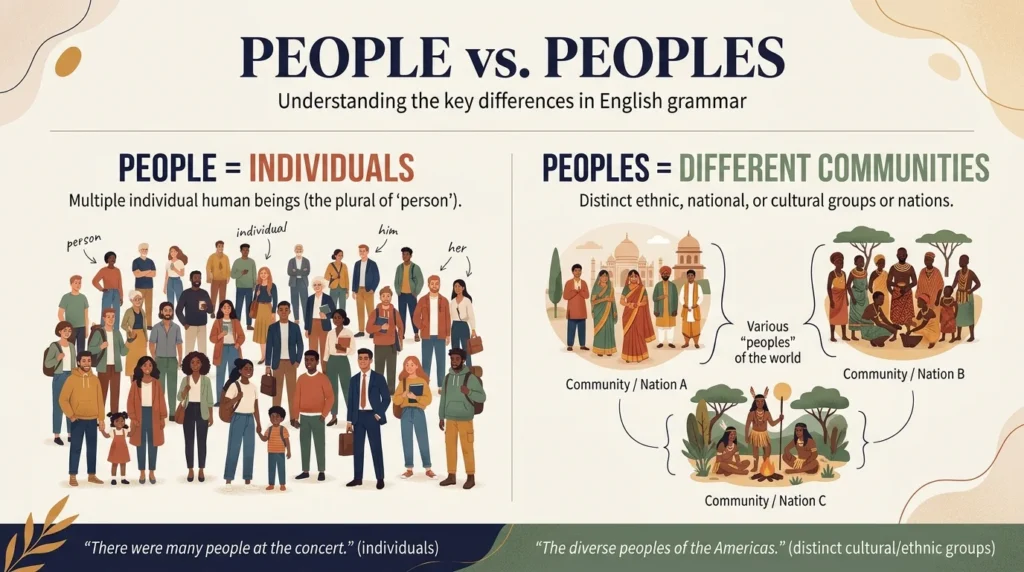

People is the standard plural form of person and refers to more than one individual. Peoples is also a correct English word, but it usually refers to multiple distinct ethnic groups, nations, or communities. The difference is mainly about meaning and context: use people when talking about individuals collectively, and peoples when distinguishing between different populations or cultural groups.
What People and Peoples Mean
Both words are correct, but they serve different purposes.
People
People is the plural of person. It refers to two or more individuals.
Examples:
- Many people attended the conference.
- People need access to clean drinking water.
- Three people were waiting outside.
- Most people prefer clear communication.
It is the normal word used when discussing individuals collectively.
Peoples
Peoples is the plural of people when people means a distinct population, nation, or cultural or ethnic community.
Examples:
- The indigenous peoples of the region have diverse traditions.
- Different peoples developed their own languages.
- The history of these peoples is fascinating.
Here, peoples refers to multiple distinct groups rather than simply multiple individuals.
The Main Difference
The main difference is what you are counting.
- People: Individual human beings considered collectively.
- Peoples: Distinct groups of people, such as nations, ethnic communities, or cultural populations.
Compare:
| People | Peoples |
|---|---|
| Many people attended the event. | The peoples of the region have different traditions. |
| People need education. | The world’s peoples have diverse cultures. |
| Several people were interviewed. | Several indigenous peoples live in the area. |
The first column counts individuals. The second identifies different populations or communities.
Also Read: Stadiums vs Stadia
The Core Rule
The Rule in Simple English
Use people when referring to multiple persons.
Use peoples when referring to multiple distinct groups of people.
Why the Rule Works
English uses people as the ordinary plural of person. However, people can also function as a collective noun meaning a nation or community.
When this second meaning is pluralized, the result is peoples.
Consider:
- The people of Japan have a rich cultural history.
- The peoples of Asia represent many different cultural communities.
In the first sentence, the people refers to the population of one country. In the second, peoples distinguishes multiple populations or communities.
How to Use It
Common Usage of People
Use people in everyday communication, business writing, education, news, and general descriptions of human beings.
Examples:
- People are waiting for the results.
- Many people use social media daily.
- The company hired 20 new people.
- People should respect one another.
Special Usage of Peoples
Use peoples when discussing different ethnic, cultural, national, or indigenous communities.
Examples:
- The indigenous peoples of Canada have distinct histories.
- The rights of all peoples should be respected.
- Ancient peoples developed different systems of writing.
- The traditions of these peoples have survived for centuries.
Peoples is more specialized and less common in everyday conversation.
Correct Examples
Here are natural examples showing how both forms work.
- Many people attended the wedding.
- People around the world celebrate different holidays.
- Several people applied for the position.
- Young people often use technology for learning.
- The company employs more than 500 people.
- The indigenous peoples of Australia have diverse cultural traditions.
- Different peoples developed unique forms of communication.
- The rights of all peoples should be protected.
- Ancient peoples created remarkable architectural structures.
- The history of these peoples deserves further study.
- Millions of people watched the final match.
- The museum explores the cultures of several ancient peoples.
Incorrect vs Correct
| Incorrect | Correct | Why |
|---|---|---|
| Many peoples attended the concert. | Many people attended the concert. | Individuals are being counted. |
| Three peoples were waiting outside. | Three people were waiting outside. | The sentence refers to individuals. |
| Several peoples applied for jobs. | Several people applied for jobs. | Applicants are individuals. |
| How many peoples are coming? | How many people are coming? | Asking about individuals. |
| Most peoples enjoy music. | Most people enjoy music. | General reference to human beings. |
| Five peoples joined the meeting. | Five people joined the meeting. | Meeting participants are individuals. |
| Peoples need clean water. | People need clean water. | Refers to humanity generally. |
| Many peoples live in this building. | Many people live in this building. | Residents are individuals. |
Important: The first column is incorrect for the intended everyday meaning. The word peoples itself is not incorrect; it is correct when referring to distinct communities.
For more helpful explanations, check out our guide to commonly confused English words.
Why People Make This Mistake
There are three main reasons.
1. People already looks plural.
Most English nouns form their plurals by adding -s, such as:
- Book → Books
- Student → Students
- Employee → Employees
Because people already refers to multiple individuals, learners may assume that adding another -s simply makes it a larger plural.
2. Confusion about collective nouns.
People can refer to individuals collectively or to a particular population as a community. Its second meaning allows the plural form peoples.
3. Assuming more people means peoples.
This is the most common misunderstanding. A crowd of 10,000 individuals is still 10,000 people, not 10,000 peoples.
Common Mistakes
Mistake 1: Using Peoples for a Large Crowd
Incorrect: Thousands of peoples gathered in the stadium.
Correct: Thousands of people gathered in the stadium.
The number of individuals does not determine whether peoples is appropriate.
Mistake 2: Avoiding Peoples Completely
Incorrect assumption: Peoples is always grammatically wrong.
Correct: The indigenous peoples of the region have different languages.
Peoples is a legitimate plural form when discussing distinct communities.
Mistake 3: Confusing People with a Single Community
A single population can be described as a people.
Example: The Kurds are a people with a distinct cultural identity.
When discussing multiple distinct populations, use peoples.
People vs Peoples in Real English
Both forms are correct, but their naturalness depends on the intended meaning.
| Context | Natural expression |
|---|---|
| Everyday conversation | People |
| Business communication | People |
| Academic discussion of individuals | People |
| Cultural anthropology | Peoples |
| Historical research | Peoples |
| Discussion of indigenous communities | Peoples |
| General population statistics | People |
| Comparison of different ethnic communities | Peoples |
In everyday English, people is overwhelmingly the usual choice.
Peoples appears more frequently in specialized discussions involving history, culture, ethnicity, nationality, and community identity.
Also Read: Center vs Centre
Comparison Table
| Feature | People | Peoples |
|---|---|---|
| Basic meaning | Multiple individuals | Multiple distinct communities |
| Grammatical form | Plural noun | Plural noun |
| Singular-related form | Person | A people |
| Main purpose | Counting individuals | Distinguishing populations |
| Everyday usage | Very common | Uncommon |
| Academic usage | Common | Common in relevant fields |
| Example | Many people work here. | Different peoples live here. |
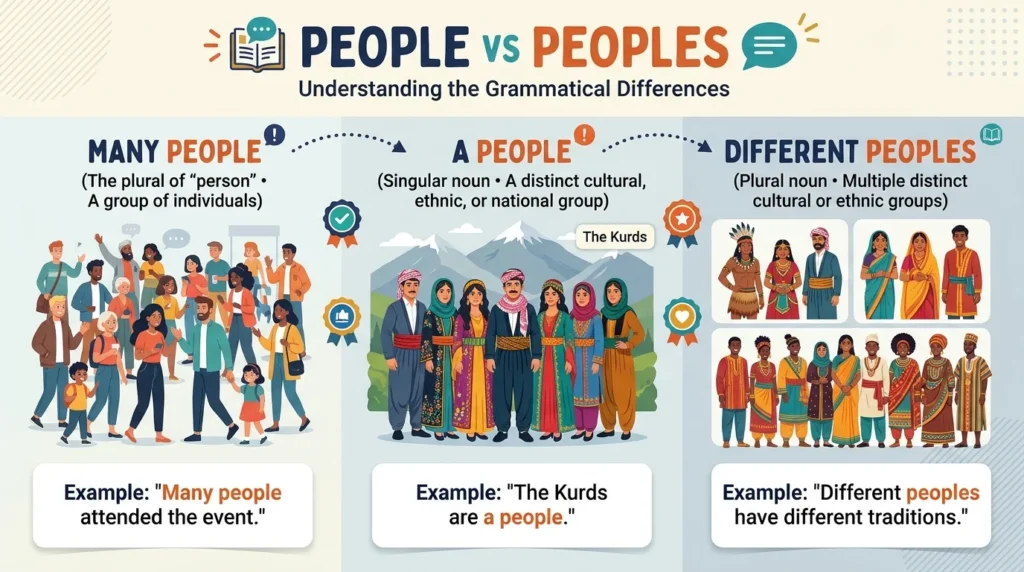
Memory Trick
Remember this simple distinction:
PEOPLE
Persons = Individuals
Think of a crowd, a classroom, employees or customers.
Many people are walking.
PEOPLES
Populations = Distinct groups
Think of different nations, ethnic communities and cultural groups.
Different peoples have different traditions.
Quick memory rule: People = individuals. Peoples = different communities.

Real-Life Examples
At Work
- Many people attended the company’s annual meeting.
- The organization works with indigenous peoples to support cultural preservation.
In an Email
- Several people have requested additional information.
- Our research focuses on the history of different peoples.
In Conversation
- How many people are coming to dinner?
- The documentary explores the traditions of ancient peoples.
At School or University
- Students are people who need opportunities to learn and grow.
- The course examines the history of European peoples.
Expert Tips
- Use people as the default plural of person.
- Do not add an s to people simply because you are referring to a large number.
- Use peoples when the sentence distinguishes multiple cultural, ethnic, national, or indigenous communities.
- Remember that a people can refer to one distinct nation or community.
- Check the meaning of the sentence before choosing either form.
For more helpful explanations, check out our guide to Commonly Confused English words.
Quick Summary
People and peoples are both correct English words, but they have different meanings. People is the standard plural of person and refers to multiple human beings. For example, you can say, “Many people attended the meeting.” Peoples, on the other hand, refers to multiple distinct populations, ethnic groups, nations, or cultural communities. For example, “The indigenous peoples of the region have different traditions.” The easiest way to remember the difference is to associate people with individuals and peoples with distinct communities. In everyday conversation and general writing, people is almost always the appropriate choice.
Frequently Asked Questions
1. Is peoples a correct English word?
Yes. Peoples is correct when referring to multiple distinct nations, ethnic groups, or cultural communities.
2. Is people the plural of person?
Yes. People is the standard and most common plural of person.
3. Can I use peoples instead of people?
Not when you mean individual human beings. Peoples changes the meaning to distinct communities or populations.
4. Why do people say peoples?
They use it when discussing multiple cultural, ethnic, national, or indigenous communities.
5. Is people singular or plural?
When it means multiple individuals, people is plural and normally takes a plural verb: “People are waiting.”
However, a people can be singular when it means one nation or community.
6. What is the singular form of peoples?
The corresponding singular is a people, meaning one distinct population or community.
7. Is peoples used in academic writing?
Yes. It is particularly useful in history, anthropology, cultural studies, and discussions of indigenous communities.
8. Is people or peoples more common?
People is much more common in general English because it is the ordinary plural of person. Peoples has a more specialized meaning.
9. Can peoples refer to different countries?
Yes, when referring to the distinct populations or communities associated with those countries.
10. What is the difference between people and a people?
People usually refers to multiple individuals. A people refers to one distinct cultural, ethnic, or national community.
If you want to learn about another commonly confused pair of English words, check out our guide to People vs Peoples
Mini Quiz
Choose the correct form in each sentence.
| # | Question | Answer | Explanation |
|---|---|---|---|
| 1 | Many ___ attended the event. (people / peoples) | People | Individuals attending an event. |
| 2 | The indigenous ___ have unique traditions. (people / peoples) | Peoples | Multiple distinct communities. |
| 3 | How many ___ work here? (people / peoples) | People | Asking about individuals. |
| 4 | Different ___ developed different languages. (people / peoples) | Peoples | Refers to distinct communities. |
| 5 | Millions of ___ use the internet. (people / peoples) | People | Counting individual users. |
| 6 | The history of ancient ___ is fascinating. (people / peoples) | Peoples | Refers to multiple ancient communities. |
| 7 | Several ___ joined the discussion. (people / peoples) | People | Individual participants. |
| 8 | The rights of all ___ should be respected. (people / peoples) | Peoples | Refers to distinct communities. |
| 9 | Many ___ live in this city. (people / peoples) | People | Refers to city residents. |
| 10 | The museum studies the cultures of different ___. (people / peoples) | Peoples | Refers to different cultural groups. |



Pingback: Seraphs vs Seraphim: Meaning, Difference & Plural Forms