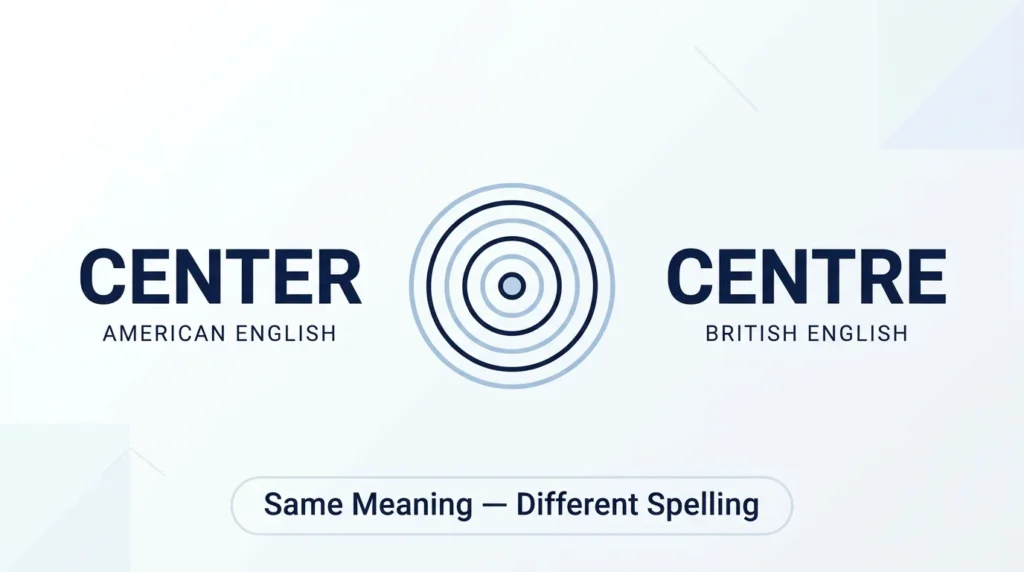

Center and centre are both correct spellings of the same English word. The difference is regional: center is the standard spelling in American English, while centre is standard in British English and many other varieties, including Canadian and Australian English. Both refer to the middle or central point of something, or a place where a particular activity happens. The meaning does not change; only the spelling convention does.
What Center and Centre Mean
Both spellings have the same meanings and grammatical uses. The correct choice depends on the variety of English you are writing.
Center
Center is the standard American English spelling. It can be used as a noun, a verb, and in certain adjective-like expressions.
As a noun, it can mean:
- The middle point of something.
- The central part of a place or area.
- A place where a particular activity, service, or organization operates.
- The main focus of attention or interest.
Examples:
- The statue stands in the center of the square.
- The city center becomes busy during the evening.
- She works at a medical center.
- Education is at the center of their campaign.
As a verb, center means to place something in the middle or make something the main focus.
Example: The designer centered the logo above the company name.
Centre
Centre has the same meanings and grammatical uses, but it is the standard spelling in British English and many other English varieties.
Examples:
- The statue stands in the centre of the square.
- The city centre becomes busy during the evening.
- She works at a medical centre.
- Education is at the centre of their campaign.
As a verb, centre also means to place something in the middle or focus something around a particular subject.
Example: The designer centred the logo above the company name.
The Main Difference Between Center and Centre
The main difference is spelling convention, not meaning or pronunciation.
| Feature | Center | Centre |
|---|---|---|
| Standard variety | American English | British English |
| Meaning | Middle, central point, or activity location | Middle, central point, or activity location |
| Part of speech | Noun and verb | Noun and verb |
| Example | City center | City centre |
| Verb past tense | Centered | Centred |
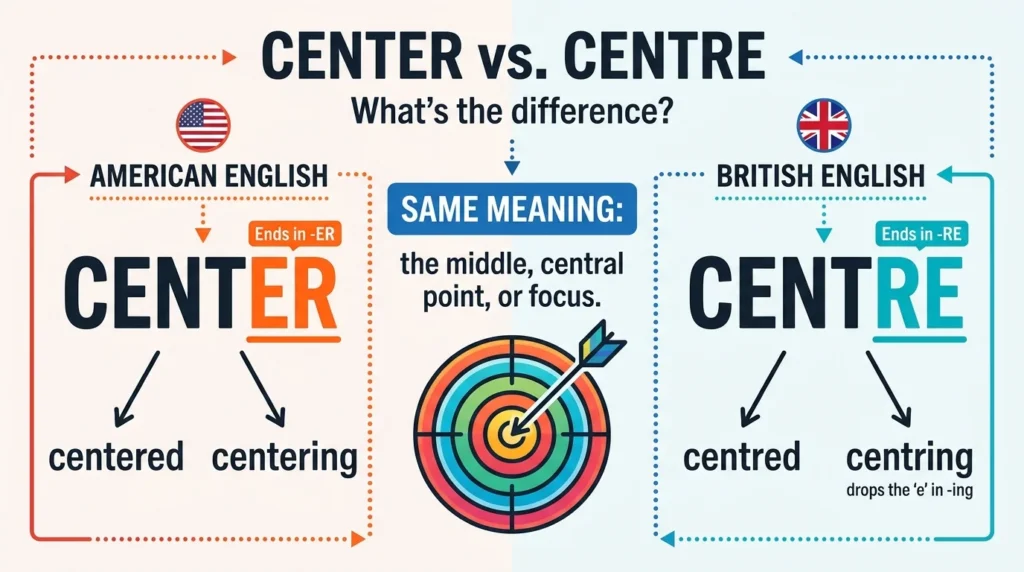
| Verb -ing form | Centering | Centring |
Both forms are correct. Neither is more accurate or more professional in every situation. The appropriate spelling depends on your intended audience and the English style you follow.
Also Read: Accommodation vs Accomodation
The Core Rule
The Rule in Simple English
Use center when writing in American English.
Use centre when writing in British English.
For example:
- American English: The new shopping center opens next week.
- British English: The new shopping centre opens next week.
Both sentences communicate exactly the same information.
Why the Rule Works
English spelling developed differently in different regions. One recurring difference is the ending -er in American English compared with -re in British English.
The same pattern appears in other word pairs:
| American English | British English |
|---|---|
| Center | Centre |
| Theater | Theatre |
| Meter | Metre |
| Fiber | Fibre |
| Caliber | Calibre |
This is a spelling convention, not a difference in grammar or meaning.
How to Use Center and Centre
Common Usage
Both forms are used in everyday, academic, business, and professional writing.
Center is commonly used in American English:
- shopping center
- city center
- community center
- research center
- health center
- center of attention
Centre is commonly used in British English:
- shopping centre
- city centre
- community centre
- research centre
- health centre
- centre of attention
The choice remains the same whether the word refers to a physical location or an abstract idea.
Using Center and Centre as Verbs
Both words can also function as verbs.
American English:
- The presentation will center on customer experience.
- She centered the photograph on the page.
- We are centering our efforts on quality.
British English:
- The presentation will centre on customer experience.
- She centred the photograph on the page.
- We are centring our efforts on quality.
Notice that the spelling difference continues in related verb forms.
Correct Examples of Center and Centre
The following examples show how the two spellings work in different contexts.
| # | American English: Center | British English: Centre |
|---|---|---|
| 1 | The hotel is near the city center. | The hotel is near the city centre. |
| 2 | The children visited the science center. | The children visited the science centre. |
| 3 | Put the table in the center of the room. | Put the table in the centre of the room. |
| 4 | The meeting will take place at the community center. | The meeting will take place at the community centre. |
| 5 | The hospital is located in the medical center. | The hospital is located in the medical centre. |
| 6 | The university is a major research center. | The university is a major research centre. |
| 7 | The discussion will center on future plans. | The discussion will centre on future plans. |
| 8 | She centered the picture above the desk. | She centred the picture above the desk. |
| 9 | The new shopping center attracts many visitors. | The new shopping centre attracts many visitors. |
| 10 | The issue is at the center of public debate. | The issue is at the centre of public debate. |
Each pair is correct in its respective spelling variety. The difference is regional spelling, not the message being communicated.
Incorrect vs Correct
Because both spellings are legitimate, using one variant in a text written consistently in the other variant is usually a style inconsistency, rather than a spelling error in every context.
The following examples show how to maintain the appropriate spelling convention.
| ❌ Inconsistent or unsuitable for the stated style | ✅ Consistent form | Why |
|---|---|---|
| American English: city centre | American English: city center | Use the American spelling. |
| British English: city center | British English: city centre | Use the British spelling. |
| American English: shopping centre | American English: shopping center | Match the American style. |
| British English: shopping center | British English: shopping centre | Match the British style. |
| American English: centered the image | American English: centered the image | This form is already correct; no correction is needed. |
| British English: centered the image | British English: centred the image | The British past-tense form uses -re. |
| American English: centring the text | American English: centering the text | The American -ing form uses -er. |
| British English: centering the text | British English: centring the text | The British -ing form uses -re. |
The first four pairs illustrate regional style choices. The last four illustrate related verb forms; one row is intentionally shown as already correct to distinguish a genuine error from an acceptable spelling.
For more helpful explanations, check out our guide to commonly confused English words.
Why People Confuse Center and Centre
People often encounter both spellings because English is used across countries with different spelling conventions.
A reader might see shopping center in an American publication and shopping centre in a British newspaper. Since the words look different but have the same meaning, it can be difficult to know which spelling to choose.
Three factors explain the confusion:
- Regional spelling: American and British English use different conventions for some word endings.
- Same pronunciation: The two spellings are generally pronounced alike within the same accent.
- International content: Websites, books, films, and business materials expose readers to more than one English variety.
The important point is that neither spelling is automatically wrong.
Common Mistakes
Mistake 1: Treating One Spelling as Universally Correct
Some writers assume that center is always correct because they see it frequently online. Others believe centre is the only correct form because they learned British English.
Both assumptions are incorrect.
Correction: Choose the spelling that matches your intended English variety.
Mistake 2: Mixing American and British Spellings
A document might use color, organize, and center in one paragraph, then switch to colour, organise, and centre elsewhere.
This inconsistency can make writing look unedited.
Correction: Follow one spelling convention throughout the document, unless you are reproducing an official name or quotation.
Mistake 3: Forgetting Related Verb Forms
The spelling difference continues when the word becomes a verb.
- American: centered, centering
- British: centred, centring
Correction: Keep the regional pattern consistent in the base word and its related forms.
Center vs Centre in Real English
Both forms are standard English. The difference is not about correctness versus incorrectness; it is about regional preference.
Correct and Natural
These are both natural:
- The city center is full of restaurants. (American English)
- The city centre is full of restaurants. (British English)
Correct but Inconsistent With a Style
A British English article that repeatedly uses center instead of centre may still be understandable, but the spelling will look inconsistent with its chosen style.
The same applies to using centre throughout an otherwise American English document.
When the Spelling Is Part of a Name
Some organizations, businesses, institutions, and official locations use a particular spelling in their registered or branded names.
For example, an organization may officially use Center even in a country where Centre is the usual spelling.
In such cases, preserve the official name rather than changing it to match your document’s general spelling style.
American vs British English
This is the central distinction between the two words.
| English variety | Preferred spelling | Example |
|---|---|---|
| American English | Center | The city center is crowded. |
| British English | Centre | The city centre is crowded. |
| Australian English | Centre | The shopping centre is nearby. |
| Canadian English | Centre | The town centre is easy to reach. |
| New Zealand English | Centre | The community centre is open. |
British-style -re spelling is common in many English varieties outside the United States. However, local conventions and official names can create exceptions, so follow the style required by your publication or organization.
Also Read: Pronunciation vs Pronounciation
Comparison Table
| Feature | Center | Centre |
|---|---|---|
| Correct spelling? | Yes | Yes |
| Main regional use | American English | British English |
| Meaning | Middle or central location; focus | Middle or central location; focus |
| Noun | Yes | Yes |
| Verb | Yes | Yes |
| Past tense | Centered | Centred |
| Present participle | Centering | Centring |
| Pronunciation | Same basic pronunciation | Same basic pronunciation |
| Best choice | US audience | UK and many Commonwealth audiences |
Memory Trick
Use this simple association:
- Center = American English
- Centre = British English
Remember the endings:
- American English usually uses -er in this word.
- British English uses -re.
You can also remember the pattern through familiar pairs:
- Theater → Theatre
- Meter → Metre
- Center → Centre
If you are writing for an American audience, choose the -er spelling. If you are writing for a British audience, choose the -re spelling.

Real-Life Examples
At Work
American English: Our company has opened a new customer service center.
British English: Our company has opened a new customer service centre.
In an Email
American English: The training session will be held at the conference center.
British English: The training session will be held at the conference centre.
In Conversation
American English: Let’s meet in the city center.
British English: Let’s meet in the city centre.
At School or University
American English: The student center is open until 9 p.m.
British English: The student centre is open until 9 p.m.
Expert Tips
- Identify your audience first. Choose American spelling for US readers and British spelling for UK readers.
- Keep related words consistent. If you write centre, use centred and centring where appropriate.
- Check your document’s spelling settings. A spellchecker configured for the wrong English variety may flag perfectly correct words.
- Follow your organization’s style guide. Universities, publishers, and companies may specify a preferred English variety.
- Preserve official names. Do not alter the spelling of a business, institution, or place name just to make it match your chosen style.
For more helpful explanations, check out our guide to Commonly Confused English words.
Quick Summary
Center and centre are two correct spellings of the same English word. Both can refer to the middle of something, a central location, or the main focus of an activity. The difference is regional: American English generally uses center, while British English and many other varieties use centre. The distinction also appears in related verb forms: Americans write centered and centering, while British-style spelling uses centred and centring. Neither spelling is universally better. Choose the version that matches your audience, follow it consistently, and preserve the official spelling of proper names.
Frequently Asked Questions
Is center or centre correct?
Both are correct. Center is the standard American English spelling, while centre is the standard British English spelling.
Is centre British or American?
Centre is the standard British English spelling. It is also commonly used in Australian, Canadian, and New Zealand English.
Is center American English?
Yes. Center is the standard spelling in American English.
Do center and centre have different meanings?
No. They have the same meanings and grammatical uses. The difference is regional spelling.
Are center and centre pronounced the same?
They have the same basic pronunciation. The exact sound may vary slightly depending on the speaker’s accent.
Should I write shopping center or shopping centre?
Use shopping center in American English and shopping centre in British English and other varieties that follow the British spelling convention.
Is centered or centred correct?
Both are correct. Centered is the American spelling, while centred is the British spelling.
Is centering or centring correct?
Both are correct. Centering is the American form, while centring is the British form.
Does Canada use center or centre?
Canadian English generally uses centre, following British-style spelling. However, official names and established terms may retain other spellings.
Can I use center and centre in the same article?
You can use both when discussing the spelling difference itself or when reproducing official names. Otherwise, choose one English variety and use it consistently throughout the article.
If you want to learn about another commonly confused pair of English words, check out our guide to Center vs Centre
Mini Quiz
| # | Question | Answer | Explanation |
|---|---|---|---|
| 1 | Which spelling is standard in American English: center or centre? | Center | American English uses the -er ending. |
| 2 | Which spelling is standard in British English? | Centre | British English uses the -re ending. |
| 3 | Complete the sentence for a US audience: The hotel is near the city ___. | Center | Center is the American spelling. |
| 4 | Complete the sentence for a UK audience: The shopping ___ is nearby. | Centre | Centre is the British spelling. |
| 5 | Is “The centre of the room” incorrect in British English? | No | Centre is correct in British English. |
| 6 | Choose the American past-tense form: centered or centred. | Centered | The American spelling retains -er. |
| 7 | Choose the British -ing form: centering or centring. | Centring | The British form uses -re. |
| 8 | Do center and centre have different meanings? | No | They are spelling variants of the same word. |
| 9 | Which spelling should you use for a US business audience? | Center | It follows American spelling conventions. |
| 10 | A British-style article uses “colour” and “organise.” Which form should it normally use: center or centre? | Centre | Centre maintains consistency with British spelling. |



Pingback: Artefact vs Artifact: Meaning, Spelling & Examples