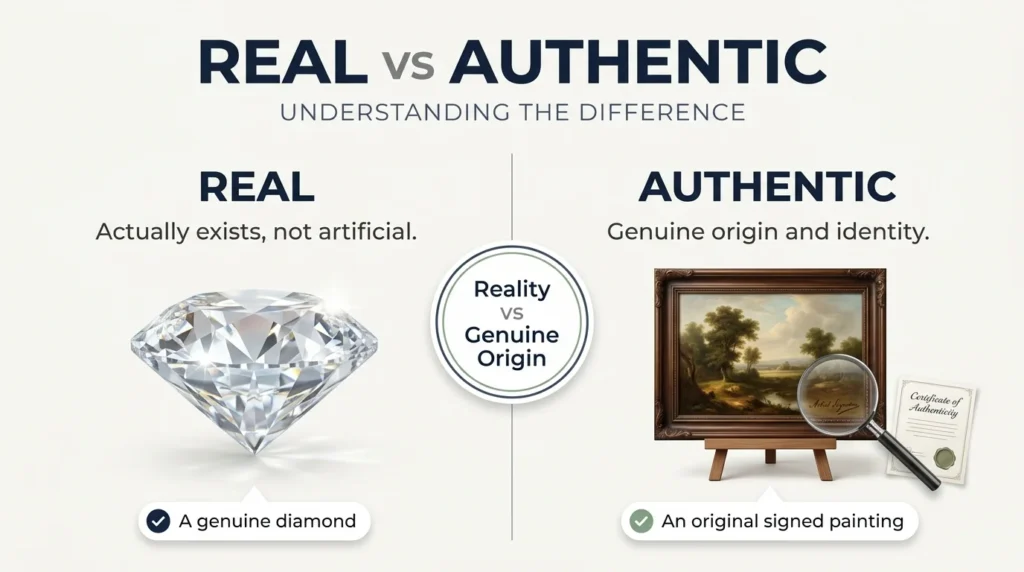

Real and authentic both describe something that is genuine rather than fake, but they are not always interchangeable. Real means something actually exists, is true, or is not imaginary or artificial. Authentic means something is genuine, original, or true to its claimed identity, source, or character. For example, a real diamond exists, while an authentic diamond is one that is genuinely a diamond rather than an imitation.
What Real and Authentic Mean
Real
Real is an adjective that describes something that exists in reality, is not imaginary, or is genuine rather than fake or artificial.
It can refer to physical objects, people, experiences, emotions, situations, and facts.
Examples:
- Is this a real diamond or a synthetic one?
- The story is based on real events.
- She is looking for a real solution to the problem.
- His fear was real, not imagined.
The central idea is actual existence or truth rather than something imaginary, false, or artificial.
Authentic
Authentic is an adjective that describes something genuine, original, trustworthy, or true to its claimed identity, source, or character.
It is particularly useful when discussing originality, identity, cultural traditions, documents, historical objects, and experiences.
Examples:
- The museum confirmed that the painting was authentic.
- This restaurant serves authentic Italian food.
- The signature on the document is authentic.
- She appreciates authentic conversations rather than artificial interactions.
The central idea is genuineness and faithfulness to what something claims to be.
The Main Difference
The main difference between real and authentic is the aspect of genuineness they emphasize.
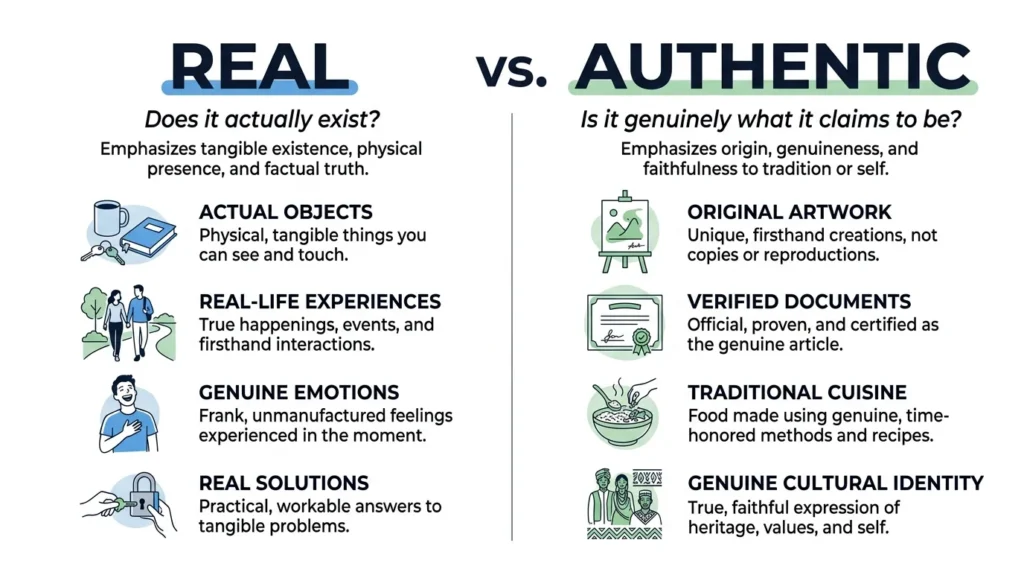
- Real focuses on whether something actually exists or is not imaginary, fake, or artificial.
- Authentic focuses on whether something is genuine, original, or faithful to its claimed identity, origin, or character.
Consider these examples:
| Situation | Natural expression | Why |
|---|---|---|
| A diamond is not artificial | Real diamond | Emphasizes genuine existence rather than imitation |
| A painting is genuinely by a particular artist | Authentic painting | Emphasizes verified origin |
| A story actually happened | Real story | Emphasizes factual events |
| A traditional dish follows its cultural roots | Authentic dish | Emphasizes traditional preparation |
| A person’s emotions are sincere | Authentic emotions | Emphasizes genuine expression |
Both words can sometimes describe the same thing.
For example, an authentic historical document is also real. However, authentic adds the idea that the document is genuinely what it claims to be.
Also Read: Conscious vs Concious
The Core Rule
The Rule in Simple English
Use real when you want to emphasize that something exists, happens, or is genuine rather than imaginary or fake.
Use authentic when you want to emphasize that something is original, genuine, or true to its claimed source, identity, or character.
Remember:
- Real = Actually existing or genuine.
- Authentic = Genuine and true to its origin or identity.
Why the Rule Works
The words overlap because authenticity is closely connected to genuineness.
However, they approach genuineness from slightly different perspectives.
For example:
- A real historical building exists in the physical world.
- An authentic historical building retains genuine historical features rather than being a modern imitation.
Similarly:
- A real signature is an actual signature.
- An authentic signature genuinely belongs to the person whose name it represents.
The difference becomes clearer when the question changes from Does it really exist? to Is it genuinely what it claims to be?
How to Use It
Common Usage of Real
Use real in these common situations:
1. Physical objects and materials
- real gold
- real leather
- real flowers
- real diamonds
- real wood
Example: This handbag is made from real leather, not synthetic material.
2. Actual events and situations
- real problems
- real experiences
- real events
- real opportunities
- real-life situations
Example: The documentary explores real problems faced by small businesses.
3. Feelings and relationships
- real love
- real friendship
- real emotions
- real concern
- real happiness
Example: She values real friendships built on trust.
4. People and existence
- real people
- real identities
- real characters
- real-life examples
Example: The movie tells the story of real people who overcame difficult circumstances.
Common Usage of Authentic
Use authentic in these common situations:
1. Original objects and artwork
- authentic painting
- authentic signature
- authentic antique
- authentic manuscript
- authentic artwork
Example: Experts examined the painting to determine whether it was authentic.
2. Food and cultural traditions
- authentic Italian food
- authentic Pakistani cuisine
- authentic traditional recipes
- authentic cultural practices
Example: The restaurant is known for its authentic traditional recipes.
3. Documents and information
- authentic documents
- authentic records
- authentic historical evidence
- authentic account
Example: The authorities verified that the documents were authentic.
4. Personality and communication
- authentic personality
- authentic behavior
- authentic communication
- authentic expression
Example: Customers often appreciate brands that communicate in an authentic way.
Less Common or Special Usage
Real also appears in expressions that emphasize seriousness or importance:
- real concern
- real challenge
- real difference
- real opportunity
Authentic can describe something that faithfully reproduces an original style or experience.
For example:
The hotel has an authentic recreation of a traditional Japanese garden.
Here, the emphasis is on faithful representation rather than simply physical existence.
Correct Examples
The following examples show how each word works in natural English.
- Is that a real gold necklace, or is it gold-plated?
- The company investigated the complaint and discovered that the problem was real.
- This documentary features real people sharing their experiences.
- I want a real explanation, not another excuse.
- Her happiness was real, and everyone could see it.
- The gallery displayed an authentic painting from the nineteenth century.
- Tourists often visit the restaurant for its authentic local cuisine.
- The researcher checked whether the historical documents were authentic.
- He believes that authentic communication creates stronger relationships.
- The company wants to build a brand with an authentic identity.
- The photograph shows a real event that took place several years ago.
- The museum hired experts to verify the authenticity of the ancient sculpture.
Incorrect vs Correct
Neither real nor authentic is universally incorrect in every situation. The following examples show expressions that are unnatural or less precise for the intended meaning.
| ❌ Less suitable | ✅ Better choice | Why |
|---|---|---|
| An original artist’s signature must be real. | The artist’s signature must be authentic. | Authentic emphasizes genuine authorship. |
| This restaurant serves real traditional Italian cuisine. | This restaurant serves authentic traditional Italian cuisine. | Authentic emphasizes cultural tradition. |
| The museum verified that the painting was real Picasso. | The museum verified that the painting was an authentic Picasso. | Authentic identifies genuine artistic origin. |
| We need an authentic solution to this imaginary problem. | We need a real solution to this problem. | Real emphasizes an actual problem and practical solution. |
| She wants authentic evidence that the event happened. | She wants genuine evidence that the event happened. | Genuine evidence is more natural in this context. |
| This is an authentic-life story. | This is a real-life story. | Real-life is the established expression. |
Important: These are context-based improvements, not universal spelling or grammar corrections. Both words can be correct in other sentence structures.
For more helpful explanations, check out our guide to commonly confused English words.
Why People Make This Mistake
There are several reasons English learners confuse real and authentic.
1. Their Meanings Overlap
Both words can describe something genuine rather than fake.
For example:
- This is a real painting.
- This is an authentic painting.
Both sentences can be correct, but the second places greater emphasis on the painting’s genuine origin or identity.
2. Both Can Contrast With Fake
People commonly use both words when discussing imitation products.
For example:
- Is this real gold?
- Is this authentic gold?
The first asks whether the gold is genuine rather than artificial. The second can emphasize whether the material or item is genuinely what it claims to be.
3. Context Changes the Best Choice
The surrounding words influence which adjective sounds more natural.
For example:
- Real experience is common when discussing something personally experienced.
- Authentic experience can emphasize a genuine or culturally faithful experience.
Learners sometimes focus on dictionary meanings without considering these contextual differences.
Common Mistakes
Mistake 1: Assuming Both Words Are Always Interchangeable
Although they overlap, they do not communicate exactly the same emphasis.
Compare:
- A real historical object exists.
- An authentic historical object is genuinely from the period or origin claimed.
Mistake 2: Using Authentic for Every Genuine Object
Authentic is not automatically better than real.
For example:
- This is a real problem. (Natural)
- This is an authentic problem. (Usually unnatural for the intended meaning.)
When discussing an actual problem, real is the natural choice.
Mistake 3: Using Real When Originality Is the Main Concern
When verifying an artist’s work, a historical document, or a genuine cultural tradition, authentic may communicate the intended meaning more precisely.
For example:
The experts confirmed that the manuscript was authentic.
This emphasizes its genuine origin.
Real vs Authentic in Real English
Both adjectives are standard English words, and neither is incorrect or outdated.
However, proficient speakers select them according to context.
Real is especially natural in everyday expressions:
- real friends
- real problems
- real money
- real life
- real experience
- real emotions
Authentic is especially useful when genuineness, originality, or faithful representation matters:
- authentic artwork
- authentic documents
- authentic cuisine
- authentic traditions
- authentic personality
- authentic communication
Can Both Words Describe the Same Thing?
Yes.
Consider a historical painting:
- It is a real painting. This establishes that the painting exists and is not imaginary.
- It is an authentic painting by the artist. This establishes that the artist genuinely created it.
The second statement communicates a more specific claim.
Therefore, the words are sometimes interchangeable, but their emphasis is not identical.
Formal vs Informal Usage
There is no strict formal-versus-informal distinction between these words. Both are acceptable in professional and everyday English.
Formal Usage
Authentic is particularly useful in academic, historical, legal, cultural, and professional contexts when discussing originality or verification.
Examples:
- The authenticity of the historical records remains under investigation.
- The researchers examined authentic historical materials.
- The museum confirmed that the artwork was authentic.
Real is equally appropriate in formal writing when discussing actual conditions or facts.
Example:
The study examines the real economic challenges faced by small businesses.
Everyday Usage
Real is common in ordinary conversations about everyday situations.
Examples:
- Is this real?
- I need a real answer.
- Are those real flowers?
Authentic is useful when talking about originality, food, traditions, and genuine behavior.
Examples:
- This food tastes authentic.
- She has an authentic personality.
- Is this an authentic designer bag?
Also Read: Center vs Centre
Comparison Table
| Feature | Real | Authentic |
|---|---|---|
| Part of speech | Adjective | Adjective |
| Main meaning | Actual or genuine | Genuine or original |
| Main focus | Existence and reality | Origin, identity and genuineness |
| Opposite | Fake, imaginary | Inauthentic, sometimes fake |
| Common contexts | Life, people, objects, feelings | Artwork, documents, traditions, food |
| Professional use | Yes | Yes |
| Everyday use | Very common | Common in relevant contexts |
| Example | A real diamond | An authentic painting |
Memory Trick
Use this simple distinction:
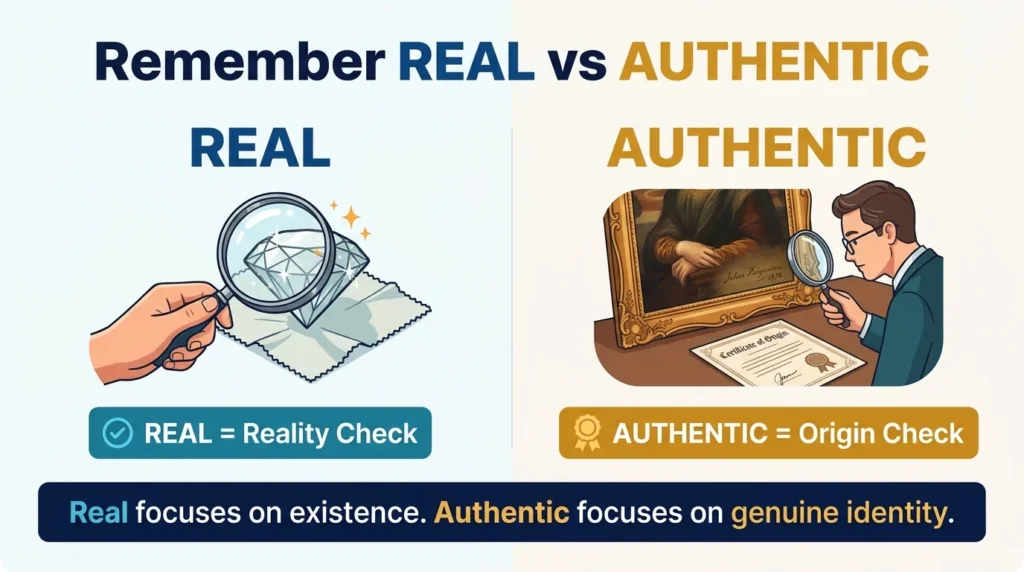
REAL
Reality check: Does it actually exist?
Think about something actual rather than imaginary or fake.
Example: A real diamond.
AUTHENTIC
Origin check: Is it genuinely what it claims to be?
Think about originality, identity, and genuine origin.
Example: An authentic Picasso painting.
Remember: Real focuses on reality; authentic focuses on genuine identity or origin.
Real-Life Examples
At Work
- We need real solutions to the company’s financial problems.
- The business wants to build an authentic relationship with its customers.
- Managers should provide real feedback instead of vague promises.
In an Email
- Please provide the real reason for the delay.
- Kindly submit authentic documents for verification.
- We appreciate your authentic feedback about our services.
In Conversation
- Is this a real diamond?
- Does this restaurant serve authentic Mexican food?
- I prefer real conversations over meaningless discussions.
- Is that an authentic designer product?
At School or University
- The students analyzed real-life business problems.
- The researcher verified that the historical sources were authentic.
- The teacher encouraged students to use real examples in their assignments.
Expert Tips
- Check the context: If you are talking about actual existence, choose real.
- Think about originality: If you are checking whether something genuinely comes from its claimed source, choose authentic.
- Learn common combinations: Remember expressions such as real life, real friends, authentic cuisine, and authentic documents.
- Do not force a distinction: Sometimes both adjectives are correct, but they emphasize different things.
- Consider the intended question: Are you asking whether something exists, or whether it is genuinely what it claims to be?
For more helpful explanations, check out our guide to Commonly Confused English words.
Quick Summary
Real and authentic both describe things that are genuine rather than fake, but their meanings have slightly different emphasis. Real refers to something that actually exists, happens, or is not imaginary or artificial. It is commonly used with people, emotions, objects, experiences, and everyday situations. Authentic emphasizes originality, genuine identity, source, or faithfulness to a tradition or claimed character. It is especially useful when discussing artwork, documents, cultural food, historical objects, and sincere behavior. For example, a real diamond is not artificial, while an authentic painting is genuinely what it claims to be. Both words can describe the same thing, but context determines which one communicates the intended meaning more clearly.
Frequently Asked Questions
1. What is the main difference between real and authentic?
Real emphasizes actual existence or genuineness, while authentic emphasizes genuine identity, origin, or faithful representation.
2. Are real and authentic synonyms?
Yes. They are synonyms in some contexts because both can mean genuine or not fake. However, they are not interchangeable in every sentence.
3. Is authentic the same as genuine?
They have very similar meanings. Authentic often emphasizes originality or a genuine source, while genuine broadly means real and not fake.
4. Can I use real instead of authentic?
Sometimes. For example, both real leather and authentic leather can describe genuine leather. However, authentic may be more appropriate when discussing the originality of artwork, documents, or cultural traditions.
5. Can a person be authentic?
Yes. An authentic person is genuine, sincere, and consistent with their actual personality rather than pretending to be someone else.
6. What is the opposite of authentic?
The most direct opposite is inauthentic. Depending on context, fake, false, or imitation may also work.
7. What is the opposite of real?
Common opposites include fake, imaginary, unreal, and artificial. The best choice depends on the sentence.
8. Is real more common than authentic?
Real is used across a broader range of everyday contexts, including existence, facts, people, and objects. Authentic is more context-specific, particularly when discussing genuine origins, traditions, and identity.
9. Is authentic formal or informal?
Authentic is appropriate in both formal and informal English. It is frequently used in academic, professional, cultural, and everyday discussions.
10. Is real-life or authentic-life correct?
Real-life is the standard expression when referring to actual experiences, people, or situations.
Example: The movie is based on a real-life story.
“Authentic-life” is not the natural equivalent.
If you want to learn about another commonly confused pair of English words, check out our guide to Real vs Authentic
Mini Quiz
| # | Question | Answer | Explanation |
|---|---|---|---|
| 1 | Is this a ___ diamond or an imitation? (real/authentic) | Real | Real emphasizes that it is not artificial. |
| 2 | The museum confirmed that the painting was ___. (real/authentic) | Authentic | It emphasizes genuine artistic origin. |
| 3 | She wants a ___ solution to the problem. (real/authentic) | Real | Real is natural for an actual, practical solution. |
| 4 | The restaurant serves ___ Italian cuisine. (real/authentic) | Authentic | It emphasizes traditional, genuine cuisine. |
| 5 | The documents were verified as ___. (real/authentic) | Authentic | Authentic emphasizes their genuine identity. |
| 6 | The film is based on a ___ story. (real/authentic) | Real | Real story is the natural expression. |
| 7 | He values ___ communication with his customers. (real/authentic) | Authentic | Authentic emphasizes sincerity and genuineness. |
| 8 | Choose the natural expression: ___ friends or authentic friends? | Real friends | Real friends is the conventional everyday expression. |
| 9 | Which word emphasizes actual existence rather than imagination? | Real | Real focuses on reality. |
| 10 | Which word emphasizes genuine origin or identity? | Authentic | Authentic focuses on originality and genuine identity. |


Pingback: Credibility vs Authenticity: Key Differences & Examples