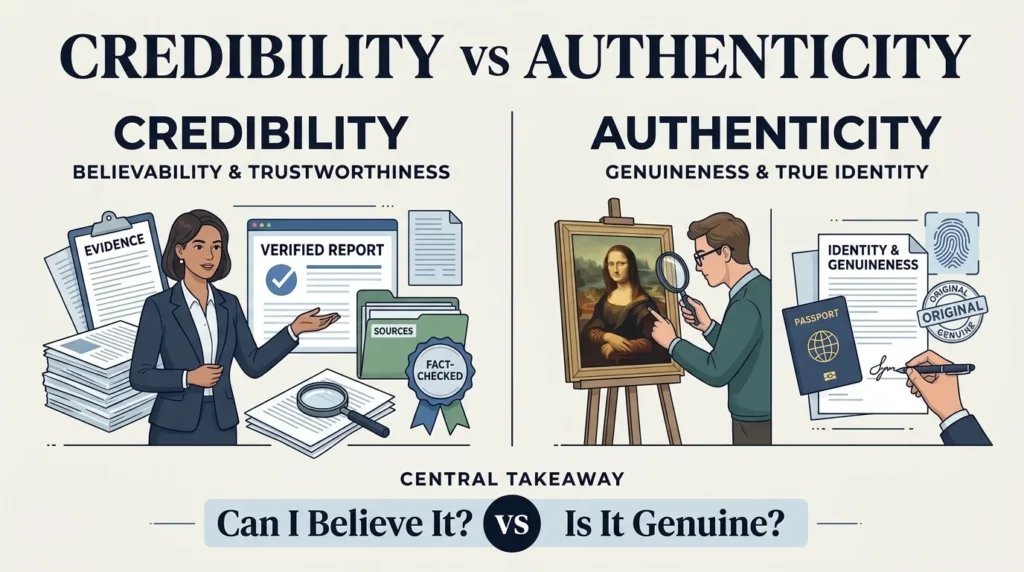

Credibility and authenticity are closely related concepts, but they describe different qualities. Credibility refers to how believable, reliable, or trustworthy someone or something is, while authenticity refers to whether someone or something is genuine, original, or true to its identity. A person can be authentic without being credible, and a source can appear credible without being authentic. The key difference is that credibility concerns trustworthiness, whereas authenticity concerns genuineness.
What Credibility and Authenticity Mean
Credibility
Credibility is a noun that describes the quality of being believable, trustworthy, or worthy of confidence.
It refers to how much people believe someone, something, or a particular piece of information. Credibility is often influenced by knowledge, experience, evidence, honesty, reputation, and consistency.
Examples:
- The journalist has built credibility through accurate reporting.
- The company’s credibility suffered after the product failure.
- The witness’s credibility was questioned during the investigation.
- Providing reliable evidence can strengthen an argument’s credibility.
The central idea is whether someone or something deserves to be believed or trusted.
Authenticity
Authenticity is a noun that describes the quality of being genuine, original, or true to one’s identity, nature, or claimed origin.
It focuses on whether something is what it genuinely claims to be rather than a fake, imitation, or artificial representation.
Examples:
- Customers appreciate the authenticity of the brand’s communication.
- Experts examined the authenticity of the historical document.
- Her authenticity makes her stand out in a world of artificial online personalities.
- The restaurant is known for the authenticity of its traditional recipes.
The central idea is whether someone or something is genuine and true to its identity or origin.
The Main Difference
The main difference between credibility and authenticity is the question each concept answers.
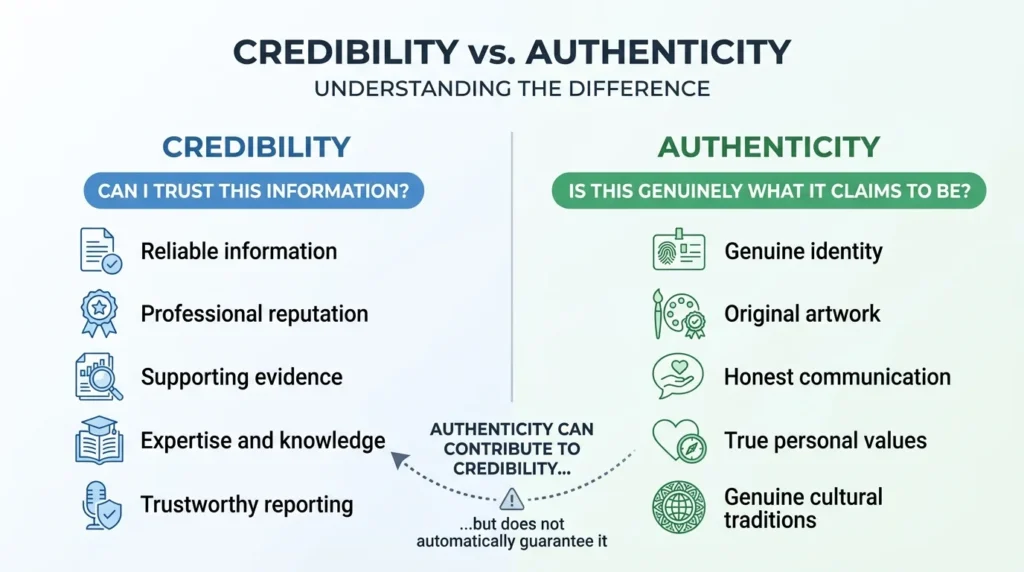
- Credibility: Can I believe or trust this person, source, or information?
- Authenticity: Is this person, source, or thing genuinely what it claims to be?
Consider a social media account that claims to belong to a financial expert.
- Its authenticity concerns whether the account actually belongs to that person.
- Its credibility concerns whether the person’s financial advice is trustworthy and supported by knowledge and evidence.
An account can be authentic but still share misleading information. Similarly, an account can appear credible because of its professional presentation while actually being operated by someone using a false identity.
This distinction is particularly important in journalism, business, education, digital communication, and personal relationships.
Can Something Have Both Credibility and Authenticity?
Yes. In fact, both qualities can strengthen people’s confidence in a person, organization, or message.
For example, a company may demonstrate:
- Authenticity by communicating honestly and remaining consistent with its stated values.
- Credibility by delivering on promises, providing accurate information, and maintaining a dependable reputation.
However, neither quality automatically guarantees the other.
Also Read: Real vs Authentic
The Core Rule
The Rule in Simple English
Use credibility when discussing whether someone or something is believable, reliable, or worthy of trust.
Use authenticity when discussing whether someone or something is genuine, original, or true to its identity.
Remember:
- Credibility = Believability and trustworthiness.
- Authenticity = Genuineness and true identity.
Why the Rule Works
The two concepts describe different ways of evaluating people, information, and organizations.
Credibility is generally an assessment made by an audience. It concerns how convincing or trustworthy a source or message appears based on factors such as expertise, evidence, reputation, and accuracy.
Authenticity concerns genuineness. It can involve verifying an identity, establishing an object’s origin, or determining whether someone’s actions and communication reflect their actual values.
For example, consider an online news article:
- Its credibility depends on the quality of its reporting, supporting evidence, and the trustworthiness of its source.
- Its authenticity may involve whether the article genuinely represents the stated author, publisher, or original material.
A genuine source can publish inaccurate information, and a convincing-looking source can be fake. That is why the distinction matters.
How to Use It
Common Usage of Credibility
Use credibility in these situations:
1. People and professional reputations
- professional credibility
- personal credibility
- academic credibility
- public credibility
- professional reputation
Example: Her years of experience have strengthened her credibility as a financial consultant.
2. Information and news
- source credibility
- media credibility
- information credibility
- news credibility
- message credibility
Example: Readers should evaluate the credibility of online information before accepting it as fact.
3. Business and organizations
- business credibility
- brand credibility
- market credibility
- corporate credibility
- organizational credibility
Example: Consistent customer service helps businesses establish credibility in competitive markets.
4. Arguments and evidence
- credibility of an argument
- credibility of evidence
- credibility of a claim
- credibility of a witness
- credibility of research
Example: The researcher presented additional evidence to improve the credibility of the argument.
Common Usage of Authenticity
Use authenticity in these situations:
1. Personality and identity
- personal authenticity
- individual authenticity
- authentic identity
- authenticity of character
- authenticity of behavior
Example: People often connect with leaders who demonstrate authenticity in their actions.
2. Brands and marketing
- brand authenticity
- authenticity in marketing
- authentic brand identity
- brand communication authenticity
- authenticity of a company’s values
Example: The company focuses on authenticity rather than making exaggerated marketing promises.
3. Art, history, and original objects
- authenticity of artwork
- document authenticity
- historical authenticity
- authenticity of an artifact
- authenticity of a signature
Example: The museum hired specialists to establish the authenticity of the ancient artifact.
4. Culture and communication
- cultural authenticity
- authenticity of traditions
- authentic storytelling
- authenticity of experiences
- authenticity in communication
Example: The filmmaker wanted to preserve the cultural authenticity of the story.
Less Common or Special Usage
Both words have specialized applications in research and communication.
Credibility can describe how audiences evaluate the believability of digital information, including websites, social media posts, and AI-generated content.
Authenticity can describe whether an online identity is genuine, whether a message faithfully represents its subject, or whether an interaction is genuine rather than artificially presented.
In these contexts, the concepts overlap but remain distinct.
Correct Examples
- The professor has earned credibility through years of academic research.
- The company’s credibility declined after several misleading advertisements.
- Strong evidence can improve the credibility of a scientific argument.
- The journalist worked hard to maintain credibility with readers.
- Customers questioned the credibility of the company’s product claims.
- The artist values authenticity more than commercial popularity.
- The museum investigated the authenticity of the historical painting.
- The brand’s authenticity is reflected in its transparent communication.
- She believes authenticity is essential for building meaningful relationships.
- The documentary preserves the authenticity of the community’s cultural traditions.
- The news organization strengthened its credibility by correcting inaccurate reports.
- Verifying a social media account helps establish its authenticity.
Incorrect vs Correct
Both nouns are grammatically correct, so mistakes generally involve choosing the wrong concept for the intended meaning rather than spelling or grammar.
| ❌ Less suitable | ✅ Better choice | Why |
|---|---|---|
| The journalist’s authenticity was damaged after publishing false reports. | The journalist’s credibility was damaged after publishing false reports. | The issue concerns trust in the journalist’s reporting. |
| Experts checked the credibility of the painting’s original signature. | Experts checked the authenticity of the painting’s original signature. | The concern is whether the signature is genuine. |
| The company needs to prove its credibility as a genuine organization. | The company needs to establish its authenticity as a genuine organization. | The intended focus is genuine identity. |
| The fake account raised questions about the person’s credibility. | The fake account raised questions about the person’s authenticity. | The concern is whether the identity is genuine. |
| Scientific evidence increases the authenticity of the research findings. | Scientific evidence increases the credibility of the research findings. | Evidence supports the believability of findings. |
| The museum questioned the credibility of the ancient artifact’s origin. | The museum questioned the authenticity of the ancient artifact. | The issue is whether the artifact is genuinely from the claimed period or source. |
| A professional qualification automatically proves authenticity. | A professional qualification can strengthen professional credibility. | Qualifications support perceived expertise and trustworthiness. |
| The brand’s credibility means staying true to its original identity. | The brand’s authenticity means staying true to its original identity. | Authenticity emphasizes consistency with identity and values. |
These are context-specific corrections. In some situations, both words can be used, but the meaning and emphasis change.
For more helpful explanations, check out our guide to commonly confused English words.
Why People Make This Mistake
1. Both Concepts Are Connected to Trust
People often associate both words with trust because genuine identities and trustworthy information can contribute to confidence.
However, being genuine does not automatically mean being trustworthy.
For example, a person may honestly express an opinion but lack the knowledge needed to make that opinion credible.
2. Both Are Used in Business and Marketing
Businesses frequently discuss brand credibility and brand authenticity together.
This can create confusion because both qualities influence how customers perceive a company.
However:
- Brand credibility concerns whether customers believe the company’s claims and promises.
- Brand authenticity concerns whether the company’s identity, values, and communication are genuine.
3. Digital Communication Blurs the Distinction
Online platforms make it possible for people to create professional-looking profiles, publish convincing information, and present carefully constructed identities.
A social media account may look credible without being authentic.
Likewise, an authentic account may belong to someone who regularly publishes inaccurate information.
4. Their Meanings Sometimes Overlap
Authenticity can contribute to credibility, especially when honesty and transparency are important.
For example, a company that communicates authentically may become more credible over time.
However, the two words do not mean exactly the same thing.
Common Mistakes
Mistake 1: Assuming Authenticity Automatically Creates Credibility
Being genuine does not guarantee that someone is knowledgeable or reliable.
For example, a person can sincerely share financial advice without having the expertise to support it.
Their authenticity may be genuine, but their professional credibility may still be weak.
Mistake 2: Treating Credibility as Proof of Authenticity
A professional appearance, strong reputation, or convincing presentation does not prove that an identity or product is genuine.
For example, a counterfeit product can be advertised through a professional-looking website.
The website may appear credible, but the product’s authenticity remains unverified.
Mistake 3: Using Both Words as Exact Synonyms
The sentence “The authenticity of the journalist is questionable” focuses on whether the journalist is genuine or true to their identity.
“The credibility of the journalist is questionable” focuses on whether the journalist deserves to be believed.
Both sentences are grammatically correct, but they communicate different concerns.
Credibility vs Authenticity in Real English
Both words are standard English nouns used in everyday communication, professional writing, academic discussions, and business contexts.
However, their natural usage depends on what is being evaluated.
When Credibility Is More Natural
Use credibility when discussing:
- A journalist’s reputation.
- A company’s reliability.
- A witness’s believability.
- The quality of scientific evidence.
- The trustworthiness of online information.
- The strength of an argument.
Example:
The researcher questioned the credibility of the study because its conclusions were not supported by sufficient evidence.
When Authenticity Is More Natural
Use authenticity when discussing:
- A person’s genuine personality.
- An original historical object.
- A brand’s true identity.
- A cultural tradition.
- An original document.
- Honest and genuine communication.
Example:
The brand gained attention because of the authenticity of its message and commitment to its original values.
Can Authenticity Improve Credibility?
Yes. Authenticity can support credibility when people value transparency, honesty, and consistency.
For example, a business that communicates openly and consistently delivers on its promises may strengthen both its authenticity and credibility.
However, credibility also depends on other factors, including expertise, evidence, accuracy, and performance.
Formal vs Informal Usage
There is no strict formal-versus-informal distinction between these nouns. Both are appropriate in professional and everyday communication.
Formal Usage
Credibility is particularly useful in academic, scientific, legal, journalistic, and professional discussions.
Examples:
- The credibility of the research findings requires further examination.
- The witness’s credibility was challenged during the proceedings.
- The organization must maintain its credibility among stakeholders.
Authenticity is especially useful in discussions involving identity, culture, originality, and verification.
Examples:
- The authenticity of the historical records remains under investigation.
- The study examines authenticity in digital communication.
- The organization emphasizes authenticity in its corporate identity.
Everyday Usage
In everyday conversation, credibility often relates to whether someone deserves to be believed.
Examples:
- He has lost all credibility.
- That explanation lacks credibility.
- Her experience gives her credibility.
Authenticity often relates to whether someone is genuine or true to themselves.
Examples:
- I appreciate her authenticity.
- Authenticity matters more than popularity.
- The brand needs more authenticity.
Also Read: Center vs Centre
Comparison Table
| Feature | Credibility | Authenticity |
|---|---|---|
| Part of speech | Noun | Noun |
| Main meaning | Believability and trustworthiness | Genuineness and originality |
| Main focus | Whether something deserves belief | Whether something is genuine |
| Key question | Can I trust it? | Is it genuine? |
| Common contexts | Research, journalism, business, evidence | Identity, culture, branding, original objects |
| Evaluation | Often audience-perceived | Often concerns genuine identity or origin |
| Opposite | Incredibility | Inauthenticity |
| Example | Credibility of a journalist | Authenticity of a brand |
Memory Trick
Use this simple two-question method:
CREDIBILITY
Believe it?
Ask: Can I trust this person, information, or claim?
Example: A journalist provides accurate and well-supported reporting.
AUTHENTICITY
Genuine?
Ask: Is this person, identity, object, or message what it claims to be?
Example: A painting is verified as an original work by the artist.
Remember:
Credibility = Can I believe it?
Authenticity = Is it genuinely what it claims to be?

Real-Life Examples
At Work
- Building professional credibility requires expertise, consistency, and dependable performance.
- Authenticity in leadership helps employees connect with managers who genuinely reflect their stated values.
- A manager can improve credibility by making realistic commitments and fulfilling them.
In an Email
- The additional evidence will help establish the credibility of our proposal.
- We appreciate the authenticity of your feedback.
- Please provide supporting documents to verify the authenticity of the submitted records.
In Conversation
- I trust her because she has established professional credibility.
- I admire his authenticity and willingness to express his real opinions.
- A convincing presentation does not necessarily guarantee credibility.
- Authenticity is important when building meaningful relationships.
In Business and Marketing
- A consistent customer experience strengthens brand credibility.
- Authenticity helps a brand communicate its actual values.
- Customers may question a company’s credibility if its advertising claims cannot be verified.
- A genuine brand identity contributes to perceived authenticity.
At School or University
- Students should evaluate the credibility of information before using it in academic assignments.
- Researchers must consider the authenticity of historical documents.
- The credibility of a research argument depends on the quality of its supporting evidence.
- The authenticity of an original manuscript may require expert examination.
Expert Tips
- Identify what you are evaluating: If you are evaluating trustworthiness, use credibility. If you are evaluating genuineness, use authenticity.
- Separate identity from expertise: A person can be genuinely who they claim to be without being an expert.
- Do not confuse appearance with proof: A professional presentation does not automatically establish credibility or authenticity.
- Learn common word combinations: Remember source credibility, professional credibility, brand authenticity, and personal authenticity.
- Consider the relationship: Authentic communication can help build credibility, but credibility also requires evidence, competence, and dependable behavior.
- Use the question test: Ask “Can I believe it?” for credibility and “Is it genuine?” for authenticity.
For more helpful explanations, check out our guide to Commonly Confused English words.
Quick Summary
Credibility and authenticity are related but distinct qualities. Credibility describes how believable, trustworthy, or worthy of confidence a person, organization, source, or message is. Authenticity describes whether someone or something is genuine, original, or true to its identity, values, or claimed origin. For example, a journalist’s credibility depends on trustworthy reporting and reliable evidence, while the authenticity of a social media account concerns whether it genuinely belongs to the person it represents. Both qualities can strengthen public confidence, but neither guarantees the other. Remember that credibility answers “Can I believe it?” while authenticity answers “Is it genuinely what it claims to be?”
Frequently Asked Questions
1. What is the main difference between credibility and authenticity?
Credibility refers to believability and trustworthiness, whereas authenticity refers to genuineness and originality. Credibility evaluates whether something deserves to be believed; authenticity examines whether something is genuine or true to its identity.
2. Are credibility and authenticity synonyms?
No. They are related concepts but not exact synonyms. Both can contribute to trust, but credibility concerns believability, while authenticity concerns genuineness.
3. Can someone be authentic but not credible?
Yes. A person can genuinely express their beliefs and be true to their identity but still lack the knowledge, experience, or evidence needed to be considered credible in a particular subject.
4. Can something be credible but not authentic?
Yes. A source may appear believable or professionally presented without being genuine. For example, a fake social media account may use convincing content and professional branding.
5. Does authenticity build credibility?
It can. Genuine communication, transparency, and consistency can strengthen people’s confidence in a person or organization. However, credibility also depends on expertise, accuracy, evidence, and performance.
6. What is the difference between brand credibility and brand authenticity?
Brand credibility concerns whether customers believe a company’s promises and product claims. Brand authenticity concerns whether the company’s identity, values, and communication are genuine and consistent with what it represents.
7. What is the opposite of credibility?
The opposite is generally incredibility, although untrustworthiness and unbelievability may be more natural alternatives depending on context.
8. What is the opposite of authenticity?
The direct opposite is inauthenticity. Other alternatives include falseness, artificiality, and lack of genuineness.
9. Is credibility more important than authenticity?
Neither is universally more important. Their importance depends on the situation. Credibility is essential when evaluating information, expertise, or professional advice, while authenticity is particularly important when evaluating genuine identity, originality, and personal expression.
10. Can credibility and authenticity be used together in one sentence?
Yes. They are often used together when discussing trust and genuine communication.
Example: The company strengthened its credibility by demonstrating authenticity in its communication and consistently delivering on its promises.
If you want to learn about another commonly confused pair of English words, check out our guide to Credibility vs Authenticity
Mini Quiz
| # | Question | Answer | Explanation |
|---|---|---|---|
| 1 | The journalist has built strong ___ through accurate reporting. (credibility/authenticity) | Credibility | Accurate reporting strengthens believability and trust. |
| 2 | Experts examined the ___ of the ancient manuscript. (credibility/authenticity) | Authenticity | The question concerns whether the manuscript is genuine. |
| 3 | A fake social media profile raises questions about the account’s ___. | Authenticity | The issue is whether the identity is genuine. |
| 4 | Reliable scientific evidence strengthens the ___ of an argument. | Credibility | Evidence makes an argument more believable. |
| 5 | A leader who remains true to personal values demonstrates ___. | Authenticity | Authenticity involves genuine identity and behavior. |
| 6 | Identify the better word: The witness’s ___ was questioned in court. | Credibility | The issue is whether the witness should be believed. |
| 7 | Identify the better word: The museum verified the ___ of the artwork. | Authenticity | The museum checked whether the artwork was genuine. |
| 8 | True or false: An authentic person is automatically credible in every professional field. | False | Genuine identity does not guarantee expertise. |
| 9 | Which concept focuses on whether information deserves to be believed? | Credibility | Credibility concerns believability and trustworthiness. |
| 10 | Which concept focuses on whether a person or object is genuinely what it claims to be? | Authenticity | Authenticity concerns genuine identity or origin. |


Pingback: Dim vs Dull: Meaning, Difference & Examples
Pingback: Stadiums vs Stadia: Which Plural Form Is Correct?