
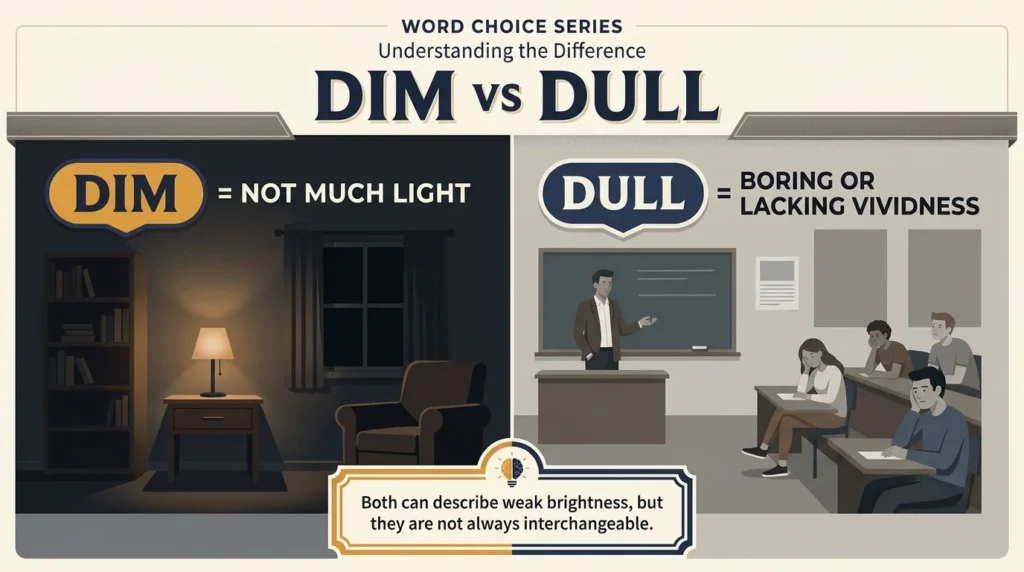

Dim and dull can both describe something that lacks brightness, but they are not interchangeable in every situation. Dim usually means that there is not enough light to see clearly, or that something is faint or difficult to remember. Dull has a wider range of meanings: it can describe something boring, a muted colour, a blunt blade, a low unclear sound, or a persistent mild pain. The right word depends on what you are describing.
What Dim and Dull Mean
Dim
Dim is an adjective that commonly describes something with little light or something that is difficult to see clearly.
Examples:
- A dim room has very little light.
- A dim lamp does not produce much light.
- A dim shape is faint or difficult to distinguish.
- A dim memory is unclear or incomplete.
Dim can also describe a person informally as not very intelligent, or a situation in which success seems unlikely.
Examples:
- The room was too dim to read comfortably.
- I have only a dim memory of that afternoon.
- His chances of getting the position look dim.
It can also be a verb: to dim the lights means to make them less bright.
Dull
Dull is an adjective with several common meanings. It often describes something that lacks interest, brightness, sharpness, or intensity.
Examples:
- A dull lecture is boring.
- A dull colour is muted rather than vivid.
- A dull knife has a blunt edge.
- A dull sound is low or unclear.
- A dull ache is a continuous pain that is not sharp or sudden.
It can also describe cloudy weather or something that has lost its shine.
Examples:
- It was a dull, grey afternoon.
- The metal surface had become dull.
The Main Difference
The central difference is the quality each word emphasizes.
- Dim focuses mainly on a lack of light, visibility, or clarity.
- Dull focuses on a lack of interest, vividness, sharpness, or intensity.
Consider these examples:
| Expression | Meaning |
|---|---|
| A dim room | A room with insufficient light |
| A dull room | A room that feels boring or lacks character |
| A dim light | A light that is not bright |
| A dull colour | A colour that is not vivid |
| A dim memory | A memory that is unclear |
| A dull lecture | A lecture that is uninteresting |
| A dull knife | A knife that is not sharp |
| A dull ache | A steady, not sharply intense pain |
The words sometimes overlap when describing weak light or a faint glow. However, they are not general synonyms. A room can be dim because it is dark, while it can be dull because its appearance is uninteresting.
Also Read: Credibility vs Authenticity
The Core Rule
The Rule in Simple English
Use dim when you mean:
- Not enough light.
- Difficult to see clearly.
- Faint or unclear in memory.
- Not very intelligent, in informal descriptions.
- Unlikely to have a positive outcome.
Use dull when you mean:
- Boring or uninteresting.
- Not vivid or shiny.
- Not sharp, especially a blade.
- Low, muffled, or unclear, especially a sound.
- Mild but persistent, especially pain.
- Cloudy or lacking sunshine, especially weather.
Why the Rule Works
The words describe different qualities, even when those qualities are related.
Imagine looking at a painting in a poorly lit room:
- The room is dim because there is not enough light.
- The painting looks dull if its colours are muted and lack vibrancy.
The first describes the lighting conditions. The second describes the appearance of the colours.
This distinction helps you choose naturally without treating the words as interchangeable.
How to Use It
Common Usage
Use dim for light and visibility.
Natural combinations include:
- Dim light
- Dim room
- Dim hallway
- Dim glow
- Dim outline
- Dim shape
- Dim memory
- Dim prospects
Examples:
- The restaurant was lit by dim lamps.
- I could see a dim outline of the building.
- She has a dim recollection of her first school.
Use dull for interest, colours, sharpness, sounds, and pain.
Natural combinations include:
- Dull movie
- Dull lecture
- Dull colour
- Dull grey
- Dull knife
- Dull sound
- Dull ache
- Dull weather
- Dull surface
Examples:
- The presentation became dull after the first few slides.
- The knife is too dull to cut the vegetables.
- He complained of a dull ache in his shoulder.
Less Common or Special Usage
Both words have meanings beyond their most familiar uses.
Dim as a description of intelligence
In informal English, dim can mean not very intelligent.
Example: The character is portrayed as kind but rather dim.
This usage can sound insulting, so it is best avoided when speaking respectfully about someone.
Dull as a description of a person
Dull can describe someone who is boring or not interesting. It can also suggest that someone is slow to understand, especially in older or more formal descriptions.
Example: He is not unfriendly, but he can be a dull conversationalist.
Dim as a verb
Dim can also be used as a verb meaning to make something less bright.
Example: Please dim the lights before the presentation begins.
Correct Examples
- The bedroom was too dim to read without switching on another lamp.
- The documentary was informative, but the opening section felt dull.
- We noticed a dim light coming from the house across the road.
- The artist chose a dull shade of brown for the background.
- I have a dim memory of visiting that museum as a child.
- The kitchen knife has become dull and needs sharpening.
- A dim outline of the mountains appeared through the morning fog.
- The speaker’s explanation became dull because it repeated the same points.
- The old photograph had a dull appearance after years of exposure to sunlight.
- The hallway remained dim even after the curtains were opened.
- She described the pain as a dull ache rather than a sharp sensation.
- The company’s future prospects looked dim after several unsuccessful projects.
- The room felt dull because it had plain walls and very little decoration.
- The fire produced a dim glow that barely illuminated the campsite.
Incorrect vs Correct
The words are not always interchangeable. The following examples show how choosing the wrong one changes or weakens the intended meaning.
| ❌ Incorrect or less suitable | ✅ Better choice | Why |
|---|---|---|
| The room was dull, so we couldn’t see the furniture. | The room was dim, so we couldn’t see the furniture. | The problem is insufficient light. |
| The lecture was too dim to keep the students interested. | The lecture was too dull to keep the students interested. | The lecture was boring, not poorly lit. |
| I used a dim knife to cut the bread. | I used a dull knife to cut the bread. | A knife that lacks sharpness is dull. |
| The walls were dim grey. | The walls were dull grey. | A muted, non-vivid colour is dull. |
| I have a dull memory of that incident. | I have a dim memory of that incident. | Dim memory is the natural expression for an unclear recollection. |
| We heard a dim thud from upstairs. | We heard a dull thud from upstairs. | Dull thud describes a low, muffled sound. |
| She felt a dim ache in her back. | She felt a dull ache in her back. | Dull ache describes a persistent, non-sharp pain. |
| It was a dim and cloudy afternoon. | It was a dull and cloudy afternoon. | Dull naturally describes grey, sunless weather. |
| The movie was dim because the story was boring. | The movie was dull because the story was boring. | The intended meaning is lack of interest. |
| Please make the screen dull so that it is less bright. | Please dim the screen so that it is less bright. | Dim can mean reduce brightness. |
Important: Some expressions can be grammatically possible in a different context. For example, a movie can look dim if its picture is poorly lit. The issue is not that one word is always wrong, but that the word must match the intended meaning.
For more helpful explanations, check out our guide to commonly confused English words.
Why People Make This Mistake
1. Both Words Can Describe a Lack of Brightness
This is the main source of confusion.
A dim light and a dull glow can both suggest weak illumination. Because of this overlap, learners sometimes assume that the two adjectives have the same meaning.
However, dim usually emphasizes the amount of light, while dull often emphasizes a lack of brilliance or vividness.
2. Both Can Describe Something That Lacks Clarity
A dim shape is difficult to see. A dull sound is difficult to hear clearly or lacks sharpness.
The general idea of reduced clarity can make the words seem interchangeable, but their natural contexts differ.
3. Their Meanings Extend Beyond Physical Objects
Both words can describe abstract ideas:
- A dim memory is difficult to recall clearly.
- A dull discussion is not interesting.
- Dim prospects suggest little hope.
- A dull performance lacks energy or excitement.
Learners may focus on their shared negative tone instead of the specific quality being described.
Common Mistakes
Mistake 1: Using Dull for a Lack of Light
When a place is poorly illuminated, dim is usually the better choice.
- Less suitable: The room was dull because the lights were switched off.
- Better: The room was dim because the lights were switched off.
However, dull room can describe a room that looks boring or unattractive.
Mistake 2: Using Dim for Something Boring
Use dull when describing a boring activity, story, lecture, or conversation.
- Incorrect for the intended meaning: The meeting was dim.
- Natural: The meeting was dull.
Dim can describe a person’s intelligence or a situation’s prospects, but it does not normally mean boring.
Mistake 3: Confusing Dull Colours with Dim Lighting
These expressions describe different things:
- Dull colours: Colours that are muted or lack vividness.
- Dim lighting: Lighting that does not provide much brightness.
A room can have dull colours and bright lighting, or vivid colours and dim lighting.
Mistake 4: Using Dim Instead of Dull for Pain
The natural expression is dull pain or dull ache when the pain is continuous and not sharp.
Example: He experienced a dull ache after exercising.
Dim vs Dull in Real English
In everyday English, the choice often depends on the noun that follows the adjective.
| If you are describing… | Natural choice | Example |
|---|---|---|
| A poorly lit place | Dim | A dim corridor |
| A weak light source | Dim | A dim bulb |
| A faint shape | Dim | A dim outline |
| An unclear recollection | Dim | A dim memory |
| A boring activity | Dull | A dull meeting |
| A muted colour | Dull | A dull green |
| A blunt blade | Dull | A dull knife |
| A low, muffled sound | Dull | A dull thud |
| Continuous mild pain | Dull | A dull ache |
| Cloudy weather | Dull | A dull afternoon |
Can Both Words Describe Light?
Yes, but the emphasis can differ.
- Dim light: Light that is not bright enough.
- Dull light: Light that lacks brilliance or looks weak and lifeless.
For example:
- The reading lamp was too dim to illuminate the page.
- The photograph looked lifeless under the dull light.
Both expressions can be correct, but dim light is the more direct choice when the amount of illumination is the issue.
Also Read: Center vs Centre
Comparison Table
| Feature | Dim | Dull |
|---|---|---|
| Main idea | Lack of light or clarity | Lack of interest, sharpness, vividness, or intensity |
| Part of speech | Adjective; also a verb | Adjective; also a verb |
| Light | Not bright | Lacking brilliance |
| Colours | Less typical for muted colours | Muted or not vivid |
| Entertainment | Not the usual word for boring | Boring or uninteresting |
| Objects | A faint or unclear shape | A blunt or non-shiny object |
| Sound | Faint or difficult to distinguish in some contexts | Low, muffled, or lacking sharpness |
| Memory | Unclear or vague | Not the usual expression |
| Pain | Not the usual expression | Continuous, not sharp |
| Example | A dim hallway | A dull lecture |

Memory Trick
Use this simple distinction:
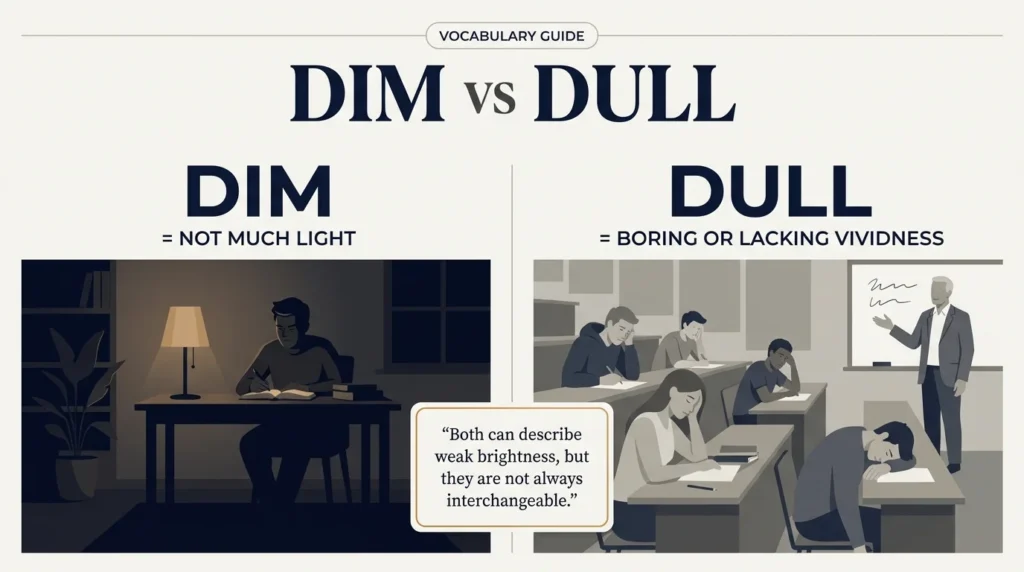
DIM = LESS LIGHT
Imagine a dark room where you can barely see.
Bedroom Lighting Ideas | Our Project | About Space
DULL = LESS INTEREST OR SHARPNESS
Imagine a boring lecture, a blunt knife, or a muted colour.
Sleek Kitchen Knife on Minimalist Gray Cutting Board for Modern Culinary Aesthetics
Remember:
- Dim room = not enough light.
- Dull lecture = not interesting.
- Dull knife = not sharp.
- Dull colour = not vivid.
Real-Life Examples
At Work
- The office conference room was dim, so the team switched on the ceiling lights.
- The training session became dull because the presentation contained too much repeated information.
In an Email
- “The meeting room is quite dim. Could we arrange better lighting?”
- “The report is accurate, but some sections feel dull and could use clearer examples.”
In Conversation
- “Can you dim the lights? I want to watch the film.”
- “That documentary was a little dull, but its final section was interesting.”
At School or University
- The students struggled to read the board in the dim classroom.
- The lecture felt dull until the professor introduced a practical experiment.
Expert Tips
- Check the noun: If you are describing a room, light, or faint shape, dim may be appropriate. If you are describing a lecture, knife, colour, or ache, dull is often the natural choice.
- Separate lighting from colour: Dim describes insufficient illumination; dull describes a lack of colour vibrancy.
- Remember common word partnerships: Learn expressions such as dim light, dim memory, dull colour, dull knife, and dull ache as complete phrases.
- Check the intended meaning: A dull room may be boring, while a dim room is poorly lit.
- Use context rather than memorizing a single synonym: Both words have several meanings, so the noun and situation determine the best choice.
For more helpful explanations, check out our guide to Commonly Confused English words.
Quick Summary
Dim and dull both describe a lack of brightness in certain contexts, but their meanings are broader and different. Use dim mainly for insufficient light, poor visibility, faint shapes, unclear memories, or situations with little hope. Use dull for boring experiences, muted colours, blunt objects, muffled sounds, cloudy weather, and continuous mild pain. For example, a dim room has little light, while a dull lecture is uninteresting. A dull knife is blunt, but a dim lamp is not bright. Although both words can describe weak-looking light, they are not interchangeable in every sentence. Always consider what quality you want to describe.
Frequently Asked Questions
What is the main difference between dim and dull?
Dim usually means lacking light or clarity, while dull commonly means boring, muted, blunt, or lacking intensity. Their meanings overlap slightly when describing light, but they are not general synonyms.
Is dim the same as dull?
No. They can both describe weak brightness, but dim focuses more on insufficient light or visibility. Dull has additional meanings, including boring, blunt, muted, and not shiny.
Is a room dim or dull?
Both can be correct, depending on the intended meaning. A dim room has insufficient light. A dull room looks boring, plain, or lacking character.
Is it dim light or dull light?
Both expressions are possible. Dim light means light that is not bright enough. Dull light suggests light that lacks brilliance or looks weak and lifeless.
What is the difference between dull colours and dim colours?
Dull colours are muted and lack vividness. Dim is not normally the preferred adjective for muted colours; it is more commonly used for low light or poor visibility.
Can a person be described as dim or dull?
Yes, but the meanings differ. Dim can informally mean not very intelligent. Dull can describe someone who is boring or, in some contexts, slow to understand. Both descriptions can sound insulting.
What does a dim memory mean?
A dim memory is a vague or unclear recollection of something. You remember it only slightly or cannot recall its details confidently.
What does a dull ache mean?
A dull ache is a continuous pain that is not sharp, stabbing, or sudden. It may feel like a steady discomfort.
Is a dull knife the same as a blunt knife?
Yes. A dull knife has an edge that is no longer sharp enough to cut effectively. Blunt is another common word for this meaning.
Can dim and dull be used in the same sentence?
Yes. They can describe different qualities in the same situation.
Example: The dim room made the dull presentation even harder to enjoy.
Here, dim describes the lighting, while dull describes the presentation.
If you want to learn about another commonly confused pair of English words, check out our guide to Dim vs Dull
Mini Quiz
Choose the most appropriate answer for each sentence.
| # | Question | Answer | Explanation |
|---|---|---|---|
| 1 | The hallway was too _____ to see the paintings clearly. (dim / dull) | Dim | The hallway does not have enough light. |
| 2 | The students found the lecture extremely _____. (dim / dull) | Dull | The lecture was boring. |
| 3 | I have a _____ memory of meeting him years ago. (dim / dull) | Dim | A dim memory is unclear or vague. |
| 4 | This kitchen knife is too _____ to cut the vegetables. (dim / dull) | Dull | A dull knife is not sharp. |
| 5 | The artist used a _____ shade of blue that lacked vibrancy. (dim / dull) | Dull | Dull describes a muted colour. |
| 6 | Please _____ the lights before the presentation starts. (dim / dull) | Dim | As a verb, dim means to reduce brightness. |
| 7 | She complained of a _____ ache in her shoulder. (dim / dull) | Dull | A dull ache is continuous and not sharp. |
| 8 | We could barely see the _____ outline of the house in the fog. (dim / dull) | Dim | Dim describes something faint or difficult to see. |
| 9 | It was a _____ afternoon with grey clouds covering the sky. (dim / dull) | Dull | Dull can describe cloudy, sunless weather. |
| 10 | The company has _____ prospects after losing its biggest customer. (dim / dull) | Dim | Dim prospects suggest little hope of success. |



Pingback: Stadiums vs Stadia: Which Plural Form Is Correct?
Pingback: Peoples vs People: Meaning, Difference & Usage
Pingback: Seraphs vs Seraphim: Meaning, Difference & Plural Forms