
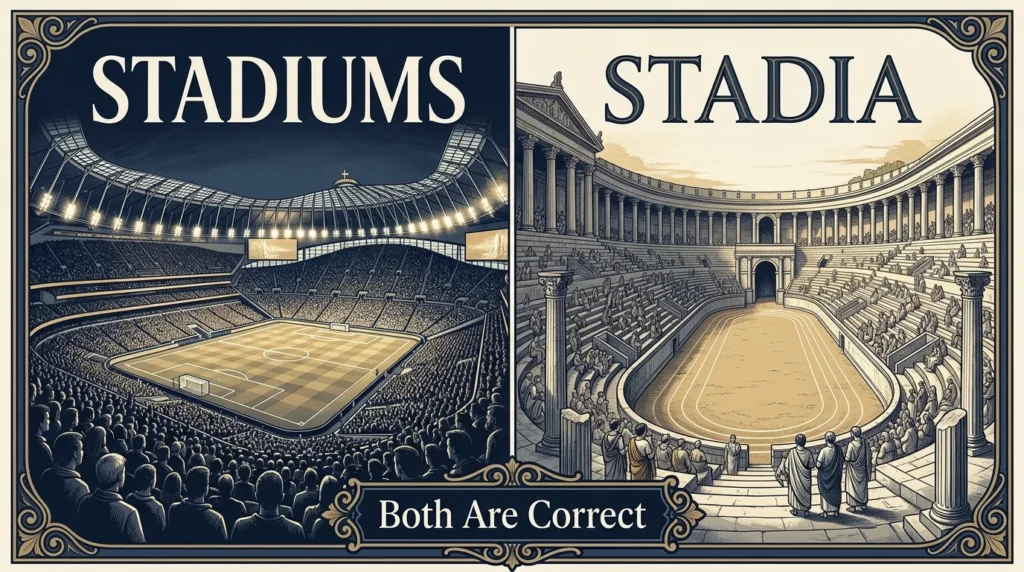

Both stadiums and stadia are correct plural forms of stadium. The main difference is their style and usage. Stadiums is the standard, widely preferred plural in modern everyday English, while stadia is a traditional Latin-derived plural that is also accepted in English. If you are writing for a general audience, choose stadiums. You do not need to consider stadia incorrect.
What Stadiums and Stadia Mean
Both words are plural nouns formed from the singular noun stadium.
A stadium is a large sports venue with seating for spectators, commonly used for football, cricket, athletics, concerts, and other events.
The difference lies in how the plural is formed.
Stadiums
Stadiums is the regular English plural of stadium. It follows the familiar rule of adding -s to a singular countable noun.
Examples:
- The city plans to build two new stadiums.
- Several stadiums will host international cricket matches.
- The country has invested in modern football stadiums.
It is the most straightforward choice for everyday communication, journalism, and general writing.
Stadia
Stadia is the traditional Latin-derived plural of stadium.
It follows a classical plural pattern in which the ending changes from -um to -a.
Examples:
- The Olympic committee inspected several stadia before selecting the venues.
- The region has developed new stadia for international competitions.
- The report compared the facilities of different stadia.
Although stadia is grammatically correct, it is less commonly chosen in ordinary modern English.
The Main Difference Between Stadiums and Stadia
The main difference is not their meaning but their plural formation and usage.
| Feature | Stadiums | Stadia |
|---|---|---|
| Singular form | Stadium | Stadium |
| Plural formation | Regular English plural | Classical Latin-derived plural |
| Meaning | More than one stadium | More than one stadium |
| Grammatical role | Plural noun | Plural noun |
| Correctness | Correct | Correct |
| Everyday usage | More common | Less common |
| Style | Standard modern English | Traditional or classical |
| Recommended choice | General writing | When preferred by a specific style or context |
The important point: Both forms refer to multiple sports venues. Choosing one does not change the basic meaning of the sentence.
Also Read: Credibility vs Authenticity
The Core Rule
The Rule in Simple English
The plural of stadium can be formed in two accepted ways:
- Stadium → Stadiums
- Stadium → Stadia
Use stadiums as the default plural in modern English.
Use stadia when you prefer the traditional classical form or when a publication’s style guide specifically requires it.
Why the Rule Works
The word stadium has a classical linguistic background. It entered English through Latin, which helps explain why it retained a traditional plural form.
In Latin, many nouns ending in -um form their plural by changing the ending to -a.
For example:
- Stadium → Stadia
- Medium → Media
- Bacterium → Bacteria
However, English has its own pluralisation system. Over time, many borrowed words also developed regular English plurals.
That is why stadiums became an accepted and widely used alternative to stadia.
Remember: A word’s Latin origin does not automatically mean that English speakers must use its Latin plural.
How to Use Stadiums and Stadia
Common Usage
In everyday English, use stadiums when talking about multiple sports venues.
Common expressions include:
- Football stadiums
- Cricket stadiums
- Olympic stadiums
- Indoor stadiums
- International stadiums
- New stadiums
- Modern stadiums
Examples:
- Several football stadiums are being renovated before the tournament.
- The country needs more international-standard cricket stadiums.
- The city has three major sports stadiums.
- Fans travelled between different stadiums to watch the matches.
- Modern stadiums offer better facilities for spectators.
Less Common or Special Usage
Stadia is suitable when a writer deliberately prefers the classical plural.
Examples:
- The architectural study examined ancient Roman stadia.
- The committee evaluated several stadia for the championship.
- The development programme includes plans for new stadia.
- The research examined the design of historic sporting stadia.
These sentences are grammatically acceptable. However, stadiums would generally sound more familiar to a broad modern audience.
Correct Examples
Here are ten natural examples showing how both plural forms work.
| # | Example Sentence | Correct Form |
|---|---|---|
| 1 | The country has built several new football stadiums. | Stadiums |
| 2 | Thousands of spectators filled the stadiums during the tournament. | Stadiums |
| 3 | The city plans to renovate its existing stadiums. | Stadiums |
| 4 | International matches will take place at different stadiums. | Stadiums |
| 5 | These stadiums can accommodate large crowds. | Stadiums |
| 6 | The report examined the architecture of ancient stadia. | Stadia |
| 7 | Several stadia were considered for the sporting event. | Stadia |
| 8 | The committee reviewed the condition of the proposed stadia. | Stadia |
| 9 | Historic stadia attract visitors interested in sports architecture. | Stadia |
| 10 | The development plan includes several modern stadia. | Stadia |
Both forms are acceptable. The choice depends on the writer’s preferred style and audience.
Incorrect vs Correct
Because both forms are correct, it would be misleading to label one as grammatically incorrect.
However, some mistakes can occur when writers misunderstand their relationship.
| Incorrect or Misleading | Correct | Why |
|---|---|---|
| One stadia was built. | One stadium was built. | Stadia is plural. |
| Three stadium was renovated. | Three stadiums were renovated. | A plural quantity requires a plural noun. |
| Two stadia is available. | Two stadia are available. | Stadia takes a plural verb. |
| Many stadium is under construction. | Many stadiums are under construction. | Many requires a plural noun. |
| The stadiums is full. | The stadiums are full. | Stadiums is plural. |
| One stadiums is nearby. | One stadium is nearby. | One requires the singular form. |
| Several stadia has been inspected. | Several stadia have been inspected. | Stadia takes a plural verb. |
| The stadium are crowded. | The stadiums are crowded. | The noun must agree with the intended plural meaning. |
Note: Writing stadiums instead of stadia, or vice versa, is not a grammatical error. Both are accepted plural forms.
For more helpful explanations, check out our guide to commonly confused English words.
Why People Make This Mistake
There are several reasons why English learners and even experienced writers hesitate between these forms.
1. The Classical Plural Rule
Many learners know that certain English words use classical plural endings.
For example:
- Criterion → Criteria
- Phenomenon → Phenomena
- Bacterium → Bacteria
- Stadium → Stadia
This can create the impression that stadia must be the only correct plural.
However, stadium also has an accepted regular English plural: stadiums.
2. Confusion About Borrowed Words
English has borrowed words from Latin, Greek, French, and other languages.
Some borrowed words retain their original plural forms, while others develop regular English endings.
Consequently, there is no universal rule that every borrowed word must preserve its original plural.
3. Formality and Traditional Usage
Some writers associate classical plural forms with formal or academic English.
This may explain why they prefer stadia in certain publications.
However, a classical form is not automatically more accurate or more professional.
Common Mistakes
Mistake 1: Assuming Stadiums Is Incorrect
Some people believe that because stadium comes from Latin, its plural must be stadia.
This is incorrect reasoning. Stadiums is an accepted English plural and is widely used.
Mistake 2: Assuming Stadia Is Incorrect
The opposite assumption is also wrong.
Stadia is a legitimate plural form and can be used in standard English.
Mistake 3: Using Stadia as a Singular Noun
Stadia is plural, not singular.
- Incorrect: The stadia is under construction.
- Correct: The stadium is under construction.
- Correct: The stadia are under construction.
Mistake 4: Mixing Plural Forms Inconsistently
Using both forms in the same document without a clear reason may make the writing look inconsistent.
Choose one form and follow it throughout the document unless a specific quotation or title requires otherwise.
Stadiums vs Stadia in Real English
In real-world English, both forms are recognised, but they do not have the same level of familiarity.
Stadiums is the natural default in contemporary everyday communication. It appears comfortably in news reporting, sports discussions, business writing, and general educational material.
Stadia is also correct, but it can sound more traditional or specialised to readers who are unfamiliar with classical plurals.
Consider these sentences:
- The government announced plans to construct five new stadiums.
- The government announced plans to construct five new stadia.
Both are grammatically correct and communicate the same basic information.
The first sentence is generally the more familiar choice for a broad audience.
Correct vs Natural Usage
| Form | Correct? | Naturalness in General English |
|---|---|---|
| Stadiums | Yes | Very natural |
| Stadia | Yes | Less common but acceptable |
| Stadium (for multiple venues) | No | Incorrect |
| Stadia (for one venue) | No | Incorrect |
American vs British English
There is no major American-versus-British spelling distinction between these two forms.
Both American and British English recognise stadiums and stadia as plural forms.
The difference is primarily between regular modern English pluralisation and traditional classical pluralisation, not between the two regional varieties.
For example:
- American English: The city has several new stadiums.
- British English: The city has several new stadiums.
Both are natural.
Formal vs Informal Usage
Formal Usage
Both forms can appear in formal writing.
Stadia may be chosen in a publication that favours classical plurals, but it is not compulsory for academic or professional writing.
Example:
The research team assessed the structural condition of several stadiums before approving the renovation programme.
Everyday Usage
Stadiums is the more familiar choice in conversations, emails, sports news, and everyday writing.
Example:
We’re visiting two stadiums during our trip.
Using stadia in conversation is not wrong, but it may sound unnecessarily formal to some listeners.
Also Read: Center vs Centre
Comparison Table: Stadiums vs Stadia
| Question | Stadiums | Stadia |
|---|---|---|
| Is it correct? | Yes | Yes |
| Is it plural? | Yes | Yes |
| Is the meaning different? | No | No |
| Is it a modern English plural? | Yes | Classical alternative |
| Is it widely familiar? | Yes | Less familiar |
| Is it suitable for professional writing? | Yes | Yes |
| Is it the recommended default? | Yes | Not usually |

Memory Trick
An easy way to remember the difference is:
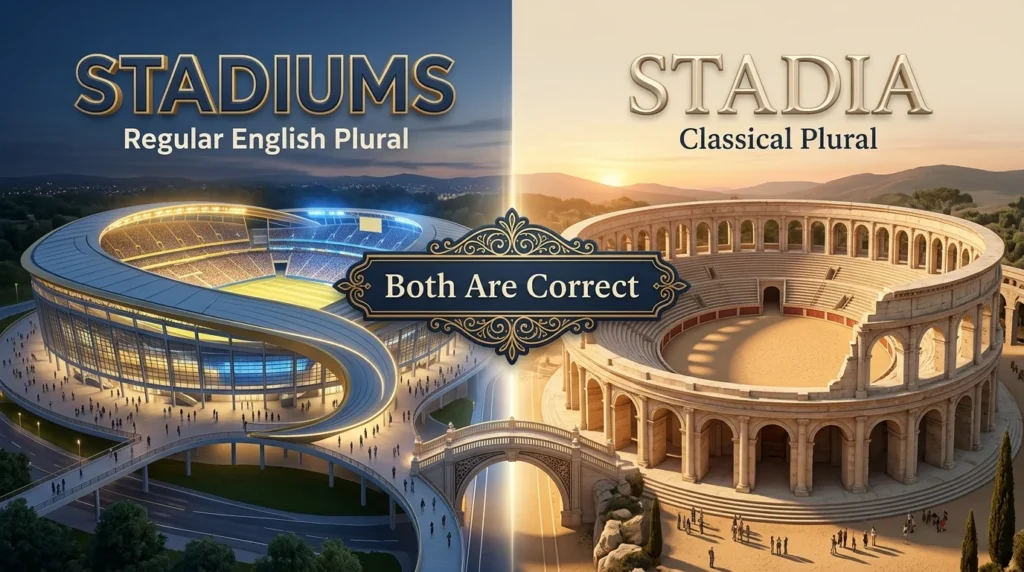
Stadiums = Standard English plural
Stadia = Classical plural
Think of the regular English ending -s when you need to describe multiple sports venues.
For example:
- One stadium
- Two stadiums
- Five stadiums
Remember that stadia is also correct. You simply do not need to use it when writing for a general audience.
Real-Life Examples
At Work
Stadiums: The construction company has submitted proposals for three new stadiums.
Stadia: The architectural team presented its assessment of the proposed stadia.
Both are acceptable in professional communication.
In an Email
Stadiums:
The report includes information about the capacity and facilities of the proposed stadiums.
Stadia:
The report includes information about the capacity and facilities of the proposed stadia.
The first version is generally the clearer choice for a broad professional audience.
In Conversation
Stadiums: How many stadiums are there in your city?
Stadia: How many stadia are there in your city?
Both questions are correct, although the first is more likely to sound familiar in everyday conversation.
At School or University
A student writing an assignment about sports infrastructure can use either form.
However, stadiums is a straightforward choice unless the instructor or publication specifies a particular style.
Expert Tips
- Choose stadiums by default: It is the most familiar plural for general readers.
- Recognise both forms: Do not mark stadia as incorrect simply because it is less common.
- Remember the singular: The singular form is always stadium.
- Check subject–verb agreement: Both plural forms take plural verbs, such as are, were, and have.
- Follow your style guide: If a publication requires stadia, use it consistently.
- Do not confuse origin with modern usage: A word borrowed from Latin can have an accepted English plural.
For more helpful explanations, check out our guide to Commonly Confused English words.
Quick Summary
Both stadiums and stadia are correct plural forms of the noun stadium. The difference is in their formation and familiarity, not their meaning. Stadiums follows the regular English plural rule by adding -s, while stadia follows a traditional Latin-derived plural pattern. In modern everyday English, stadiums is the more familiar and practical choice. Stadia remains grammatically acceptable and may appear in formal, traditional, or specialised writing. Neither form should be treated as universally incorrect. If you are unsure which one to use, choose stadiums for general communication and follow any specific publication style requirements.
Frequently Asked Questions
1. Is stadiums or stadia correct?
Both are correct. Stadiums is the regular English plural, while stadia is the traditional Latin-derived plural.
2. What is the plural of stadium?
The plural of stadium can be either stadiums or stadia. Both forms are accepted in standard English.
3. Is stadia grammatically correct?
Yes. Stadia is a grammatically correct plural form of stadium. It follows the traditional Latin-derived plural pattern.
4. Why is stadia the plural of stadium?
The word stadium has a Latin linguistic history. In Latin, certain nouns ending in -um form their plural by changing the ending to -a. This produces stadia.
5. Is stadiums more common than stadia?
Yes. Stadiums is generally the more familiar and widely preferred form in modern English, particularly in everyday communication.
6. Can I use stadia in academic writing?
Yes. Stadia is acceptable in academic writing. However, stadiums is equally valid, and the choice should follow the publication’s preferred style.
7. Do stadiums and stadia have different meanings?
No. When used as plurals of stadium, both words refer to more than one sports venue. Their difference is in plural formation and usage.
8. What is the singular form of stadia?
The singular form of stadia is stadium. For example, one stadium and two stadia.
9. Should I use stadiums or stadia in professional writing?
Use stadiums unless your organisation or publication prefers the traditional form stadia. Stadiums is clear, familiar, and appropriate for professional communication.
10. Do American and British English use different plurals?
No significant difference exists. Both American and British English recognise stadiums and stadia as accepted plural forms.
If you want to learn about another commonly confused pair of English words, check out our guide to Stadiums vs stadia
Mini Quiz
Test your understanding of the difference between stadiums and stadia.
| # | Question | Answer | Explanation |
|---|---|---|---|
| 1 | Which is the regular English plural of stadium? A) Stadia B) Stadiums | Stadiums | It follows the regular English plural rule. |
| 2 | Is stadia grammatically correct? | Yes | It is an accepted classical plural. |
| 3 | The city has three new _____. | Stadiums | This is the familiar modern plural. |
| 4 | What is the singular form of stadia? | Stadium | Stadia is a plural noun. |
| 5 | True or false: Stadiums is incorrect because stadium comes from Latin. | False | Stadiums is an accepted English plural. |
| 6 | The committee inspected several historic _____. | Stadia | Stadia is a valid plural form. |
| 7 | Which form is generally more familiar in everyday English? | Stadiums | It is the more widely used modern form. |
| 8 | Complete the sentence: The stadiums _____ full. | Are | Stadiums takes a plural verb. |
| 9 | Do stadiums and stadia have different meanings? | No | Both refer to multiple stadiums. |
| 10 | Which form should you normally choose for general writing? | Stadiums | It is the clearest default for a broad audience. |



Pingback: Peoples vs People: Meaning, Difference & Usage